Tag: DIY

  • Mochila Cards

    Mochila Cards

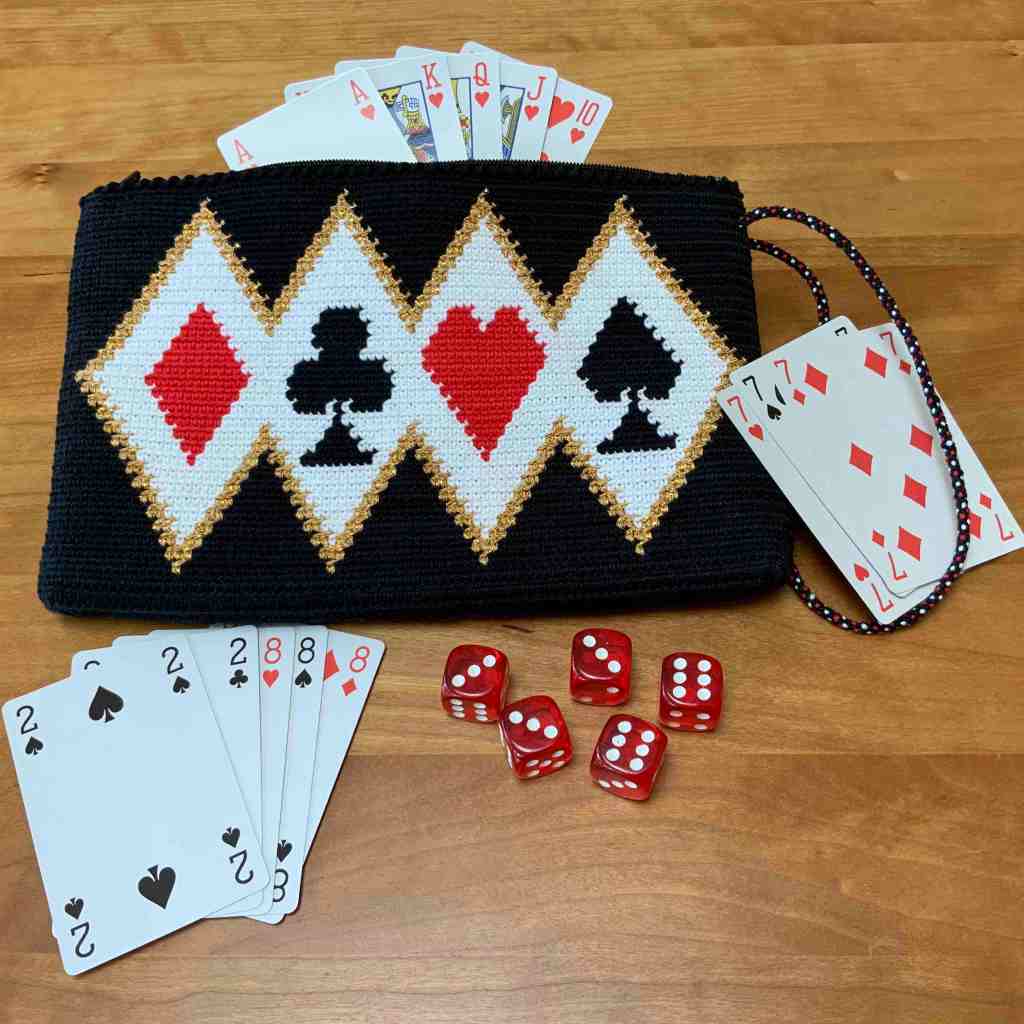
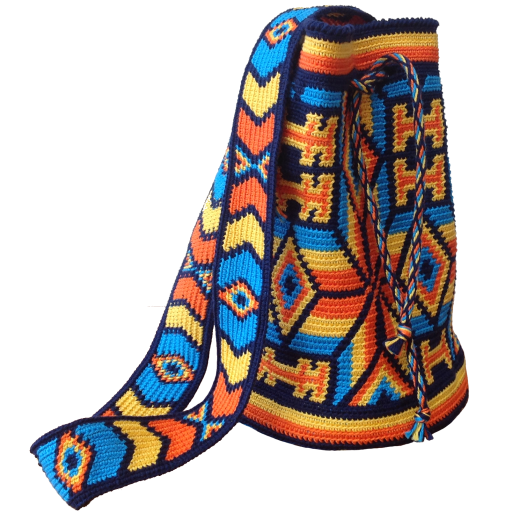
    It has been very quiet here for a while, but I have been working on a new design. I have made something totally different this time. My new Mochila does not have a geometrical pattern, but symbols of playing cards. The shape of this Mochila is also new to me.

    I got the idea for making this Mochila, when I heard that a friend of my oldest son is a professional poker player. Now that I had an idea for a design, I had to think about what kind of shape I wanted to make. 
    Then I thought, who would want a Mochila with card symbols on it and what would they use it for. Somebody who plays card games, might want to use it to put their cards, dice and fiches in it. So a clutch would be a good size. 
    I never made a clutch before, so I decided that this Mochila was going to be a clutch.

    When I think of poker, I think of diamonds and gold and of course about losing a lot of money💰 When you make a clutch with playing cards symbols on it, you need some bling bling, like gold yarn, right?
    I googled and found two gold yarns with glitters. Durable Glam and Scheepjes Twinkle. Both yarns are a combination of 75% cotton and 25% Polyester. 
    The color of Durable Glam is a bit warmer. That is the one I decided to use.

    Crocheting tight Mochila stitches with this glittery yarn was a bit hard, so I was glad it was only an accent color. Even thought it was a bit hard to crochet with the gold yarn, I am really happy that I used it, because it gives the clutch a little oomph. 

    The finishing touches of a Mochila, always take more time than you think. I added a wristlet to the clutch and closed it with a zipper. Sewing in the zipper was a real challenge. For some reason I thought I could sew it in straight, without pinning it to the clutch first. That was a big mistake. The zipper parts did not line up at all. 
    When I closed the zipper, the clutch was pulled out of shape and it looked really bad.
    I had to undo all the sewing. Time to start again. This time I sewed the zipper to the clutch with a basting stitch and then I did the actual sewing. I have no clue why I did not do that in the first place. Maybe I was a bit lazy 🙄 🫣
    Reference: Mochila Cards

  • Silver Play Button

    Silver Play Button

    On February 19, 2015 I made my first video. I didn’t know anything about making videos back then (and it shows 😂).

    I wanted to show somebody in a Facebook group how to start a Mochila, made the video, posted it on YouTube and that made it easier to share.

    About 1,5 years and a few videos later, my husband heard that I had 30.000 views on my videos. He said: You have to turn on monetising. Our sons said: That is a lot of effort for only a few bucks.

    My husband turned it on anyway and I kept making videos.

    At first I couldn’t make a decision about what language I should speak, Dutch or English, so I didn’t speak at all. Of course it also took some guts, to start talking in the videos. Cause lets be honest, it is strange to hear your own voice. Finally I decided to speak English, so more people could understand me.

    Nowadays all my videos have closed captions. That means that on the YouTube website you can turn on (good quality) subtitles in many languages. Unfortunately this option is not (yet) available in the YouTube app.

    On February 15, 2021 I reached the incredible number of 75.000 subscribers. That made me so happy and proud. My sons then told me that when I would reach 100.000 subscribers, I would get a Silver Play Button. I said: A WHAT? I had no idea what it was, so they showed me a picture. 

    For the past year I kept a close watch on the number of subscribers. There were moments that that number grew very fast and then there were moments that it didn’t go so fast anymore.

    February 1, 2022 was the day that I reached 100.000 subscribers. I kept refreshing the YouTube Studio app to see the number of subscribers jump from 99.999 to 100.000 😅

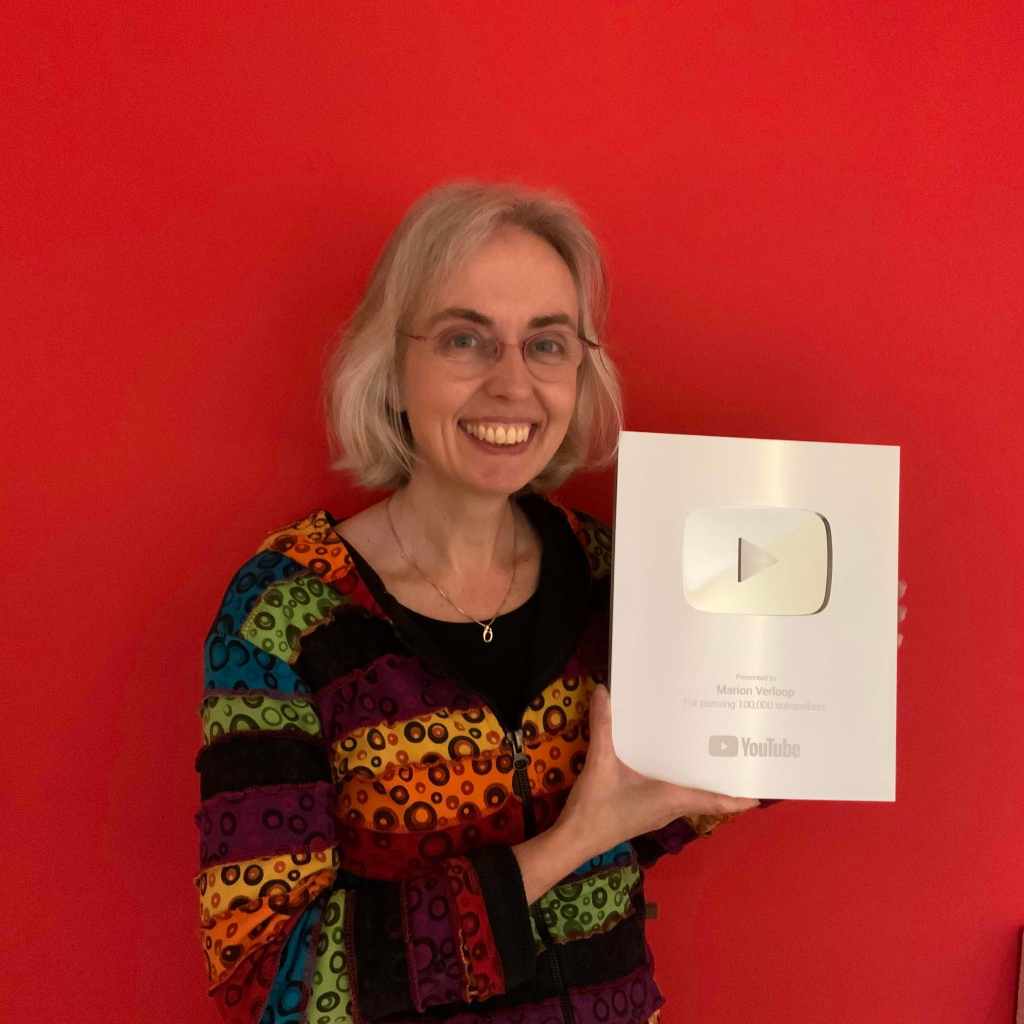
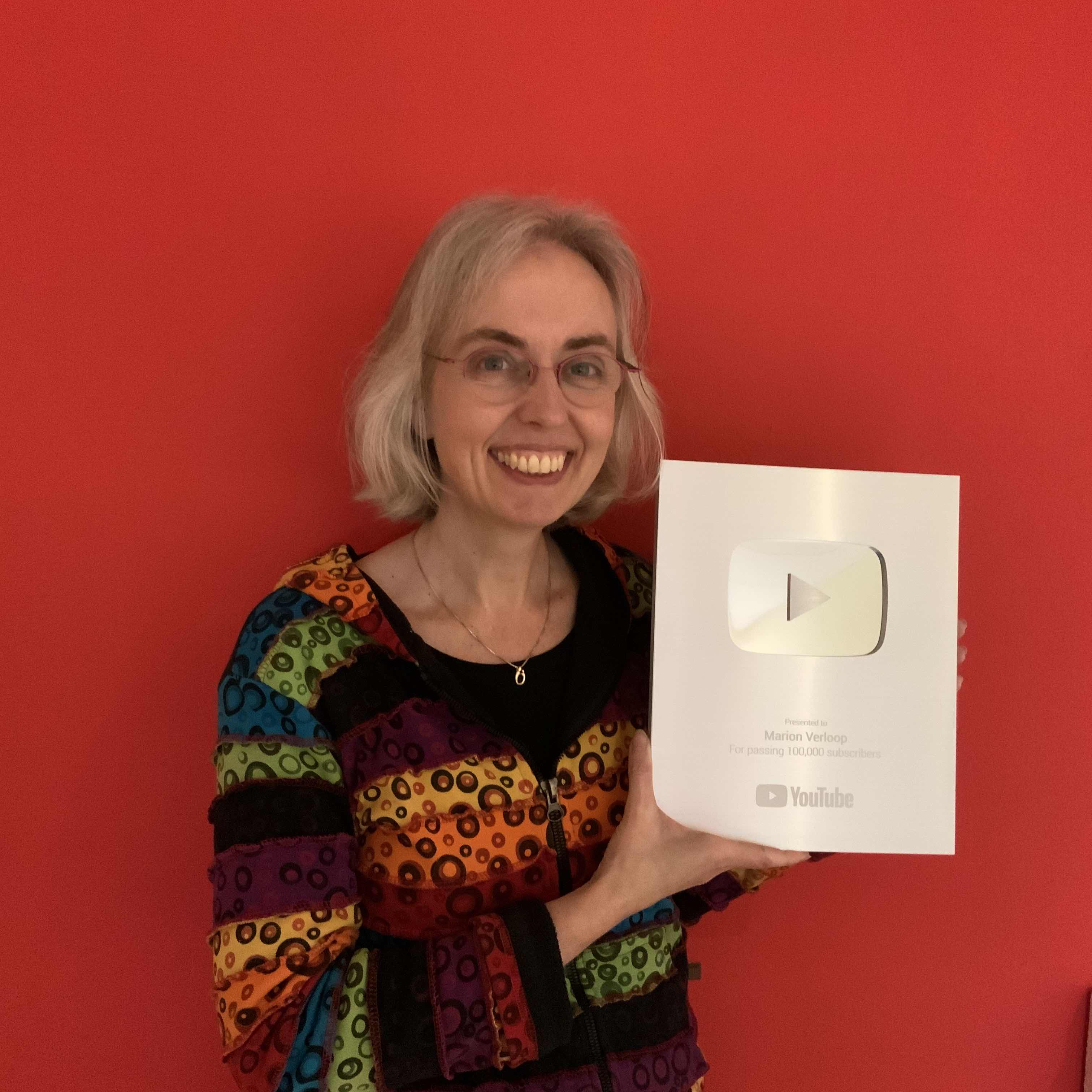
    On Februari 22, 2022 I received a creator award, The Silver Play Button. I am so proud.

    In my videos you see my hands and you hear my voice. What you don’t see is all the work my husband, Cor 😘, does to improve the quality of the videos. Thank you for all your support hubby.

    I also want to thank everybody who subscribed to my channel, everybody who watches my videos, everybody who follows me on Instagram/Facebook/Ravelry and everybody who bought my patterns. Without all of you, this would not have been possible.

    YouTube Silver Play Button awarded to crochet and weaving creator Marion Verloop.

    I hope to publish more videos to help you create a beautiful Mochila.

    Thanks everybody 🙏🤗

  • Blog Mandala Cordial

    Blog Mandala Cordial

    When I started making Mochilas, crocheting a bottom was no fun for me. I could never get the bottom to lay flat. Fortunately I found out that I just needed more than 8 increases to make a flat and firm bottom. Since then, I love making bottoms.

    In the summer of 2020, I had the idea to make a mandala with the Mochila technique. Around that time it became very popular in the Netherlands to make mandala’s in lace crochet technique.

    It is such a shame that you never see the bottom of a bag, so I thought: Now it is time to show off how beautiful a ‘big bottom’ can be. And what better way to show a bottom than to hang it on my wall.

    What does mandala mean?

    The word mandala comes from an ancient Indian language, Sanskrit and literally means “magic circle” or “magic wheel”. The circular designs symbolises the idea that life is never ending and everything is connected.

    The outer edge of a mandala is round, this is also called the “circle of life”.

    The inside of the circle offers a safe protective space, in which you can find peace and tranquility with yourself.

    The dot in the middle, the center, symbolises the combined primal force. Where everything is connected.

    The number of repeats in a mandala also have a meaning. My mandala starts with a 6 repeat and later it is a 12 repeat.

    (If you made 10 increases, the mandala starts with a 5 repeat and later it will be a 10 repeat.)

    The number 6 is one of the most harmonious single-digit numbers. It is a sign of completeness. The number 6 is the embodiment of the heart. It represents unconditional love and the ability to support, nurture and heal.

    The number 12 is considered a perfect number, it symbolises god’s power and authority. 12 is a symbol of cosmic order. 12 is the number of space and time. There are 12 months in a year. Maybe that is why it took me 12 months to crochet this mandala. 😄

    In September 2020, my husband and I went on a super relaxing holiday to Gran Canaria. On this beautiful island I designed this mandala. The Mandala is named after our hotel.

    When we came back home, I started crocheting it. The first 20 rounds went really fast. It is so much fun to see a new project grow, right?

    By round 24 it didn’t go so fast anymore, I already had 275 stitches in that round and every 2 stitches there was a color change.

    When I started this project, I thought that it would be less work than making a Mochila bag, but boy was I wrong.

    My husband calculated how many stitches there were left to do. This was a shocking number, 21.605! 😳

    21.605 stitches left to do, this is crazy. Then I got to thinking: How many stitches are there for the side of an average size Mochila. When you have 250 stitches and the side pattern is 55 rounds high, you have to make 13.750 stitches. So making this madala was much more work than making a normal size Mochila bag. I never would have guessed that.

    I didn’t have the nerve to calculate how many stitches there are in the complete mandala, while I was crocheting it. Afterwards, I did make the calculations. This mandala has almost 25.000 stitches!

    The bigger the mandala got, the harder it was to work on it. Because of the hyper-mobility of my hands, I took breaks and I worked on other projects. That is why it took so long to finish it.

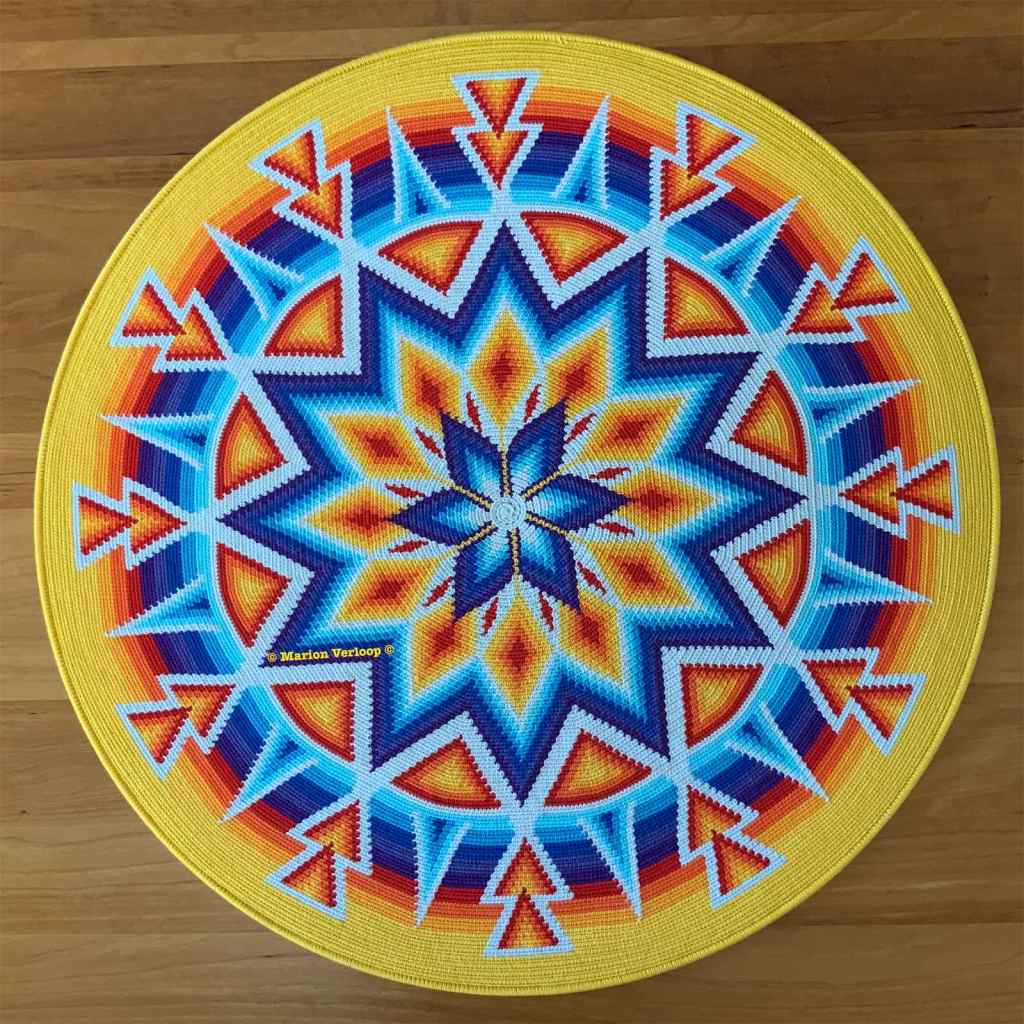
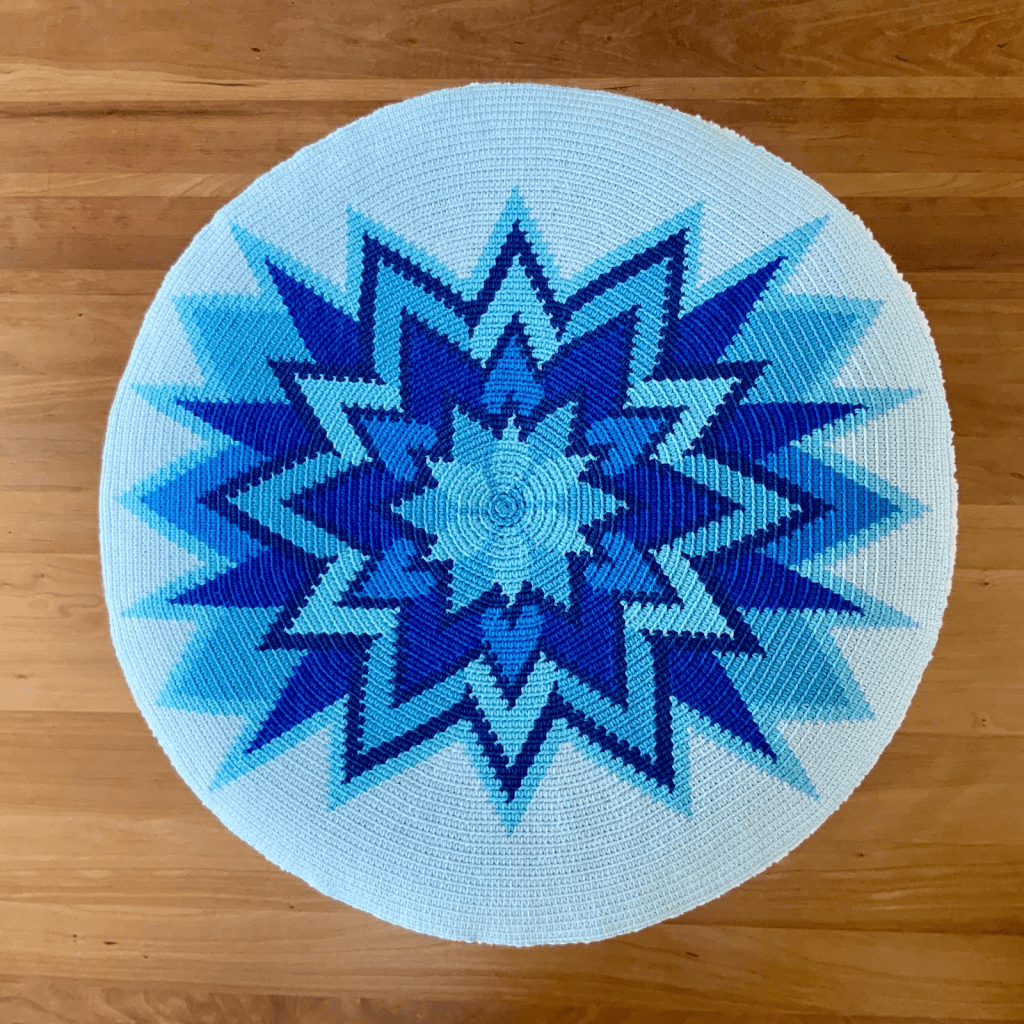
    Crochet Mochila Mandala Cordial – colorful circular bag pattern by Marion Verloop

    Reference: Mandala Cordial

  • Mochila Phone bags

    Mochila Phone bags

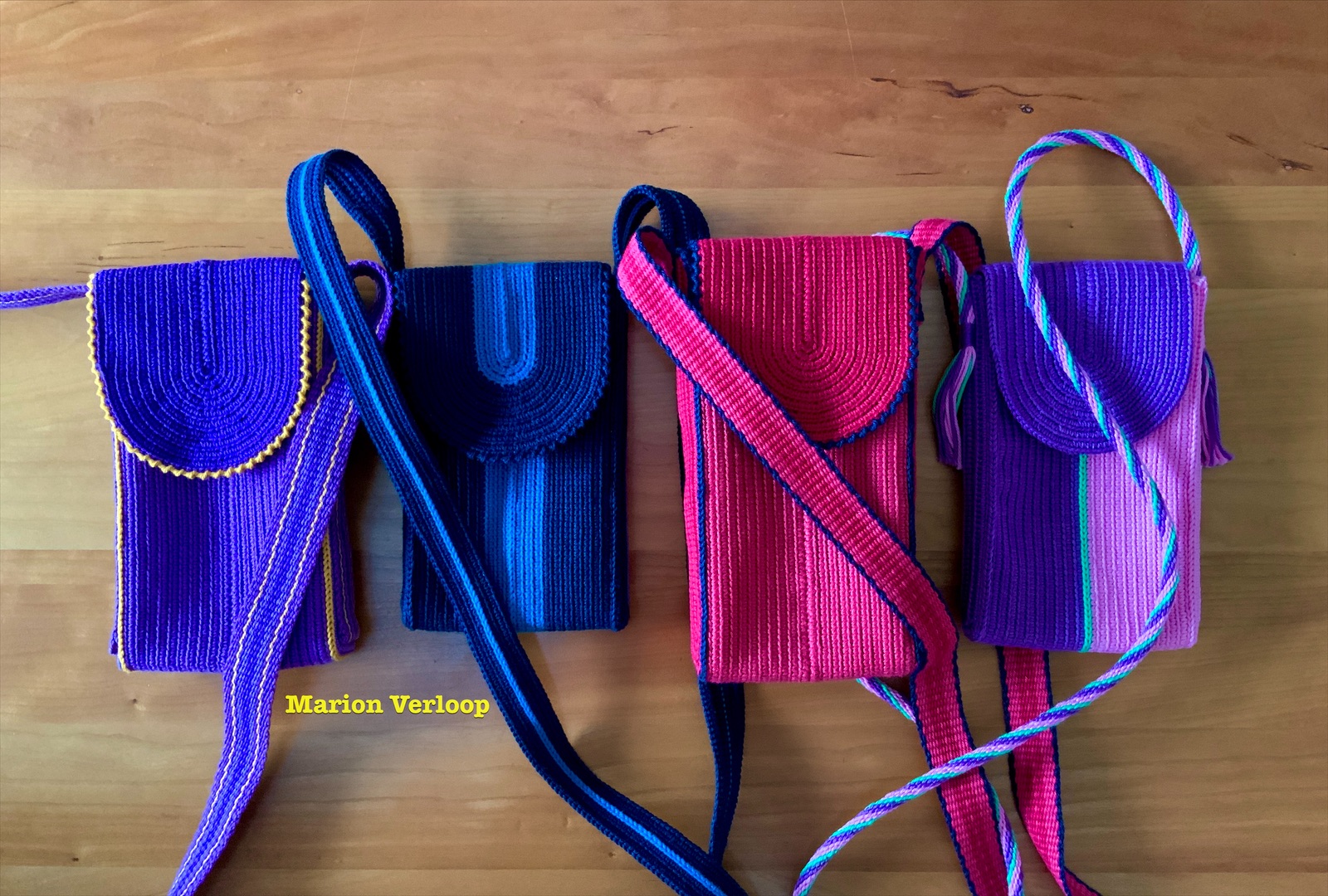
    I have just released a new pattern for a phone bag. Well, not one phone bag, but four different versions.

    When I am on vacation with my husband, I always take a Mochila with me. We usually go to a nice sunny country, so time to wear my colorful dresses. A colorful Mochila doesn’t really match well with a colorful dress. That is why I came up with the idea to make a small phone bag with nice colors, which is not too colorful. My phone is usually all I take with me anyway.

    When I talked to my husband about it, he said: Why don’t you make different sizes and use different colors. Hence the 4 phone bags (sizes are mentioned in the pattern).

    Some of you may have seen, in the Facebook group or on Instagram, that I was working on a Mochila with 10 colors. I put that Mochila on hold and started to make a sketch for the design of the phone bag. I looked in my stash and found strawberry red and wine red, so time to start.

    Unfortunately I made a little mistake when I calculated how many rounds the side should be and that also effected the stitch count for the main part. There were too many rounds for the side, which makes it wider. When I discovered the mistake, I was already too far along to correct this mistake, so I decided to finish the bag. It was a good test to see if the concept worked and fortunately it did.

    When it was finished, my husband said: This version will be good for people who have 2 phones. So that is why this version ended up in the pattern. This phone bag has a plain weave strap.

    I took another dive in my stash and found violet, pink and lime green for the next phone bag. It is a really narrow one. That is why I decided to make a Kumihimo cord for the strap. The Kumihimo cord has a nice spiral pattern, with a little bit of lime green in it.

    It was a real challenge for me not to make it too colorful. 😅 My first idea was to attach the side pieces with lime green, but I decided against it because it would become too colorful again and I was trying to avoid that this time. So there is only a vertical lime green line in the middle of the phone bag.

    Wayuu-inspired tapestry crochet phone pouches in pink, purple, blue, and mixed colors by Marion Verloop

    When I first came up with the idea to make a phone bag, I immediately thought about using two purple colors and gold. Unfortunately Catania, my favourite yarn, does not have the colors I had in mind, so I started looking at other brands.

    Gründle Cotton Quick had three purple colors. Making good pictures of purple is very hard. That is why I wasn’t sure which ones I would like best, so I ordered all three. I liked them all, so I used all three.

    I used a gold color to attach the side pieces and for the crab stitch around the flap. I think the gold gives it very stylish look.

    For this version I attached the woven strap over the whole side. I am really happy with the result and I cannot wait to use it.

    When I told my mother in law I was making phone bags in different sizes and colors, she said: You should make one in colors that men would like. So I let my husband choose the colors and the color placement for the next one.

    He chose ocean blue and navy blue. This phone bag is also very narrow and has a crocheted strap. When this version was finished, I asked Marieke: Is this manly enough. Her answer: No, but this women likes it very much.

    Let’s hope it will be possible to go on a vacation in the near future.

    For me, it is now time to continue with my 10 color Mochila, which is a lot more work than I anticipated. Hopefully I can show you that design soon.

    Reference: Mochila Phone bag

  • Mochila Messenger

    Mochila Messenger

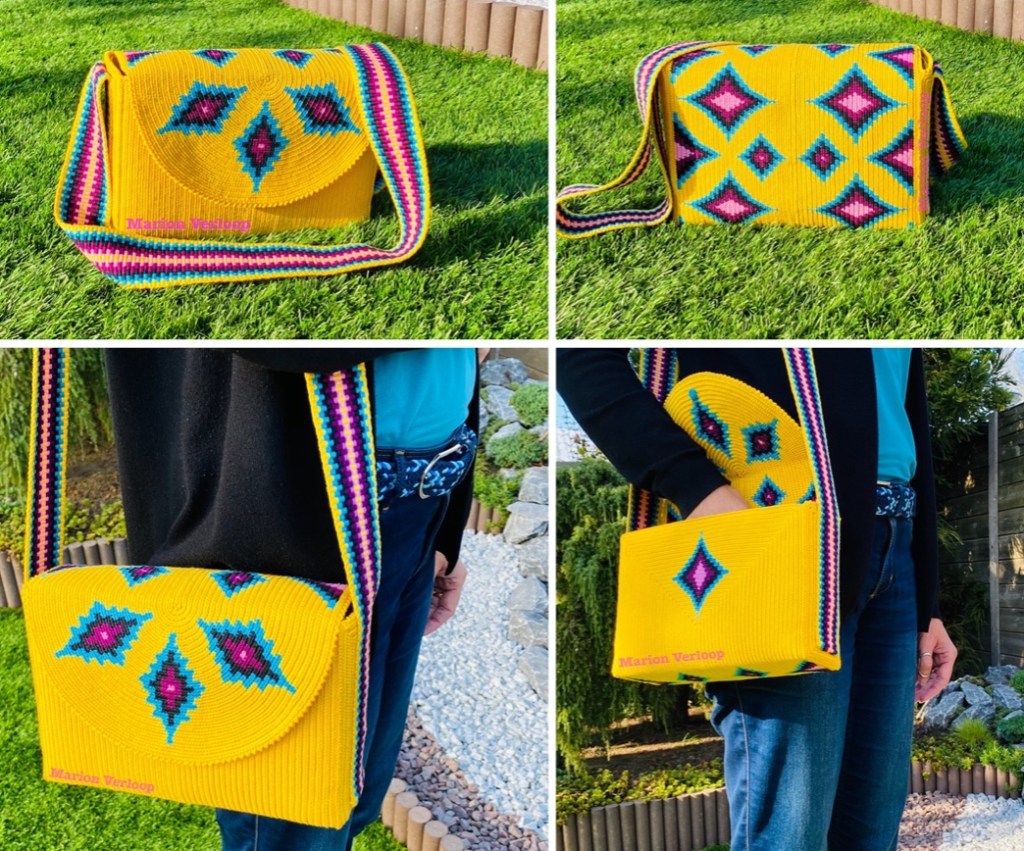
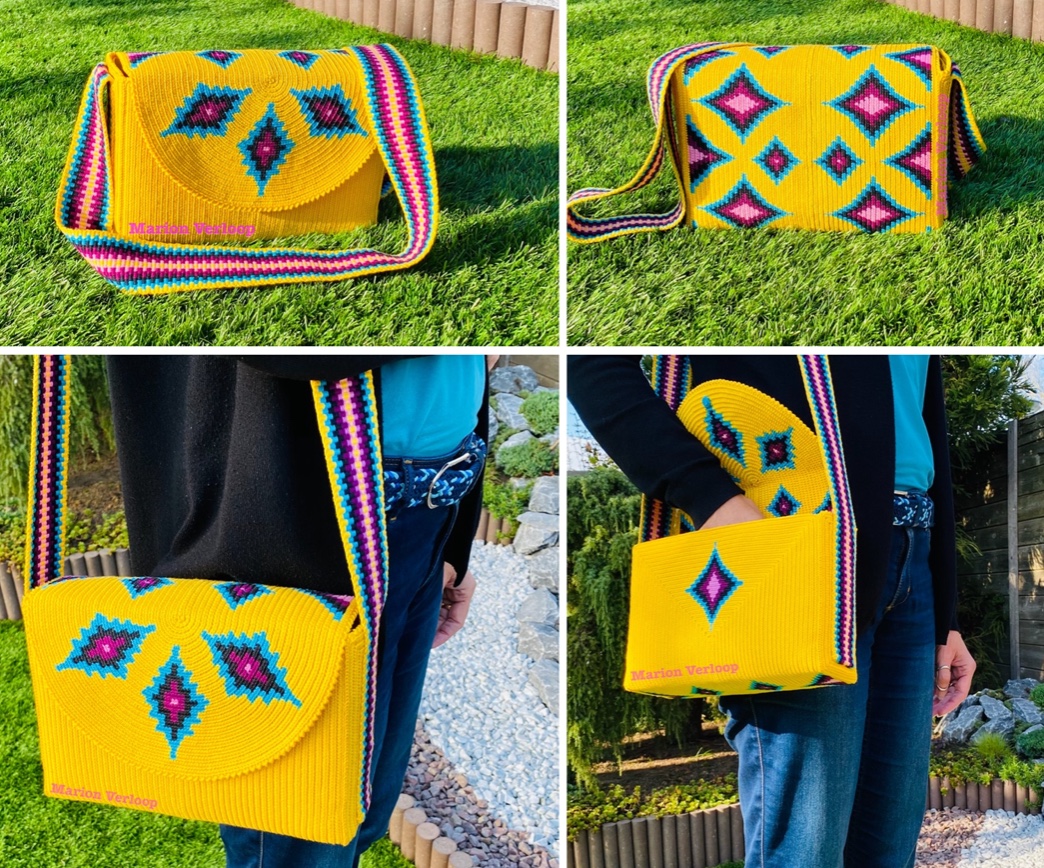
    It is finally time to show my new bag ‘Mochila Messenger’. The shape of this Mochila looks most like a messenger bag, hence the name. I am super proud that I could make a Mochila in this shape.

    I wanted to make a new Mochila, which is about the same size as my ‘Mochila Feather’, but a bit more practical to use. I had a shape in mind that I never saw before, made with the ‘Mochila technique’. Transferring this idea to an actual usable pattern was a big challenge.

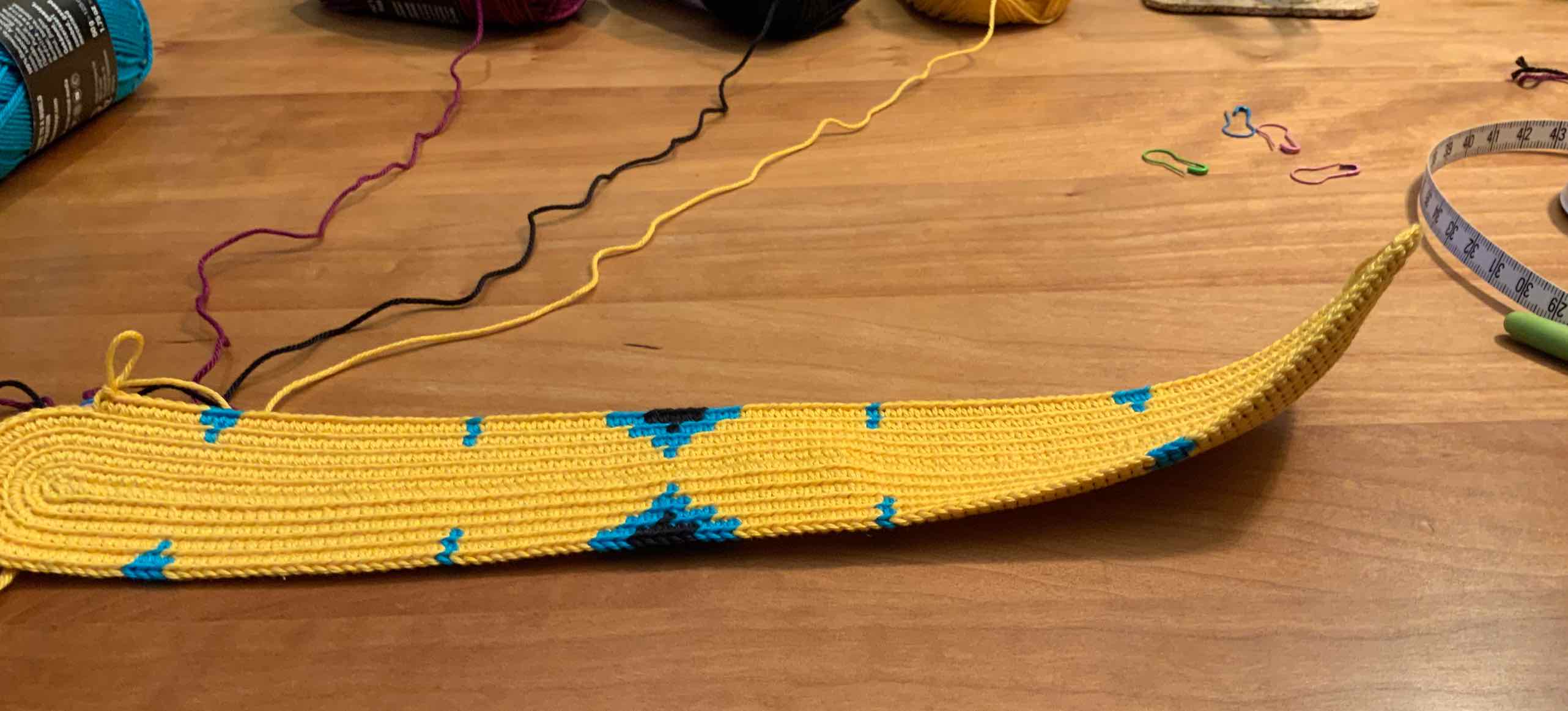
    For this Mochila it is necessary to make square corners. I tried and failed a few times, because the corners were a bit round.

    While crocheting this bag, I noted everything I did: crocheting, frogging, when I ran out of yarn and when I didn’t work on it at all.

    Mochila Messenger bag made with tapestry crochet in unique rectangular shape, designed by Marion Verloop.

    Let me tell you the inside story of how this Mochila came to life.

    In April 2019 I had an idea for a new Mochila with a completely different shape, so I made a sketch of it and saved it on my iPad.

    In September I started designing. After a while it looked okay, but after all I wasn’t 100% happy, so I put it away for a while. In December I started over from scratch and this time I was happy with the design. I made a paper version of the bag and glued the pattern parts on it. The idea I had in my mind for this shape was finally visible and then I thought; This could be possible.

    Time to start crocheting. Unfortunately, halfway round 5 it was looking like a banana-boat.

    I was too eager to start and didn’t pay enough attention to my stitches. And as you all now, Mochila stitches need all your love and attention.

    I started again, making sure to keep an even tension this time.

    After 7 rounds it was frog-time again. The part that needed to be square was too round. I tested a different way to get the corners more square. The test piece looked good so I started again.

    From January to May all my time got sucked up by the ‘2020 cal’ and other projects so there was no time to continue.

    In June I started working on it again. Unfortunately after 10 rounds, the frog 🐸 payed me another visit. The corners were still not super square and it didn’t want to lay flat. Time to ask for help. I asked one of the members of the Facebook group how she made square corners.

    I made another test piece, but couldn’t do it exactly like she did. Using a slightly different methode, I was able to make super square corners.

    I changed my design a bit to adjust the dimensions of the Mochila and started all over again. Three times is a charm, right? After round 6, I got distracted by other projects. Does this sounds familiar? 🙃

    In August I picked it up again, then it went really fast. By the end of August everything was crocheted and halfway September my Mochila was finished

    Now it was time to write the pattern. So why, you might wonder, did it take me until the end of November to finally publish this pattern?

    Writing this pattern was as much of a challenge as making this Mochila and I kept procrastinating it. I can be very good at that. 😇

    It was impossible for me to make the graphs in any program I know, so my son made all the graphs for me. Thank you Christiaan and also thanks for reviewing the pattern.

    I had to make videos for this Mochila pattern and even that was harder than normal. These days the whole family is at home all the time so I ordered them to be quiet 🤫, to film without being disturbed.

    Now that everything is finished and the pattern is published, I can finally start using my new Mochila.

    Reference: Mochila Messenger

  • Polyester yarn

    Polyester yarn

    In the Indonesian Mochila Facebook group you see beautiful bags made with polyester yarn, so that made me curious about the yarn. I really wanted to see and feel this yarn with my own eyes and hands.

    In Indonesia, cotton is hard to come by and it is very expensive, that is why they use polyester yarn. The word polyester sounds like plastic to me. So I thought that must be very stiff and hard to work with.

    Thanks to Catlien Zoet, I have some left overs of 3 different polyester yarns. Catlien, who lives in Indonesia, sent the left overs to my sister in law in Jakarta. My parents in law, who were visiting them, brought it back to the Netherlands for me. Thank you so much for doing this Catlien.

    First impression

    The first thing I noticed, is that the ends of the yarns feel hard and are black. When you cut this yarn, it unravels. To prevent this you can make a knot in the end or you hold the end of the yarn in fire to melt the ends together. That is why the end is black.

    The second thing I noticed, is that all three yarns are twined in a Z-twist. Recommended cotton is twined in an S-twist.

    Time to test

    After the first impression I started crocheting with the yarns.

    I used a 2 mm hook and I carried 4 yarns.

    I tested ‘Poly Apple’ first. The sheen on the ‘Poly Apple’ is the nicest of the three yarns. When you look at ‘Poly Apple’ you would think it is the same size as ‘Schachenmayr Catania’.

    When I started crocheting with ‘Poly Apple’, I didn’t like it at all. It is incredibly hard to work with this yarn. It was curling around itself a lot, it splits a lot and it felt very hard, a bit like plastic. 2 rounds, with this yarn, are 1.2 cm high. With ‘Catania’ 2 rounds are 0.9 cm high.

    I made a coaster with this yarn.

    Crocheted coaster and small basket made with polyester yarn, tested for Mochila-style crochet by Marion Verloop.

    My next test was with ‘Poly Cherry’. ‘Poly Cherry’ looks slightly thinner than ‘Catania’. To my surprise it was much nicer to work with the ‘Poly Cherry’ than I expected.

    The yarn did not curl so much and it didn’t split. The stitches are exactly the same size as with ‘Catania’. 2 rounds, with this yarn, are 0.9 cm high. The crocheting feels softer than with ‘Poly Apple’.

    I made two little bottoms and crocheted them together and closed it with a zipper. It became a wallet.

    The ‘Poly Mamirli’ looks a lot thicker and it feels really soft. Maybe that is because it is loosely twined. It took some time to get used to this yarn. This yarn is also curling around itself a lot and it splits a lot. The longer I crocheted with it, the better I could handle the splitting.

    Because this yarn is loosely twined, it covers the yarns you carry very good.

    2 rounds, with this yarn, are 1.1 cm high, so it is a thicker than ‘Catania’.

    I made a small basket with this yarn.

    Crocheted coaster and small basket made with polyester yarn, tested for Mochila-style crochet by Marion Verloop.

    Conclusion

    With all three yarns you can make a firm bag.

    I like ‘Poly Cherry’ best. It is the easiest of all three yarns to work with and the size of the stitches is the same as with ‘Catania’ (mercerised cotton yarn, 125 meter per 50 gram).

    My second choice would be ‘Poly Mamirli’. Keep in mind that your bag will be bigger with this yarn.


    Please let me know what your experience is with these yarns, in the comments.


  • Sometimes you feel like you need to make a gift.

    Sometimes you feel like you need to make a gift.

    In November 2019 I started designing and making coasters as a present for my friend Marieke Kranenburg for her new weave studio.

    Marieke and I often give weaving lessons together. We used to do this in her kitchen and living room. 4 students in the kitchen and 4 in the living room and Marieke and I running back and forth between kitchen and living room to help everybody

    Last year she got a great opportunity to buy part of a building, adjacent to her backyard. She transformed it into a beautiful weave studio, big enough for 12 students.

    By the time the studio was finished, our country was in lock down because of Covid 19 and unfortunately Marieke had to cancel the opening of the studio.

    In July it was finally possible to start giving weaving lessons. The only downside was, it was only possible to have 4 students at a time because of social distance. So she did not need my help to give the lessons 😔

    I did see pictures of the studio, but that is just not the same as seeing it for real.

    Last week I was finally able to go to Marieke to admire the studio and give her the coasters for her studio. She did a great job, it has become very beautiful.

    Normally I show everything I am working on to Marieke, so it was very hard to keep the coasters a secret.

    Handmade crochet coasters and a small crochet basket — a personal gift for a new weaving studio.

    When the coasters were finished, I thought; This would be a nice beginner project. So I decided to write a pattern for the coasters. That turned out to be a lot more work than I anticipated. The pattern is available in English and in Dutch and it is the longest pattern so far (42 pages).

    All the coaster patterns have written instructions for 10 and 12 increases and I have also added graphs for 10 and 12 increases with the increases marked.

    I want to thank my son for making the graphs for me.

    Reference: Coasters

    Marieke Kranenburgs new studio

  • The ‘jog’

    The ‘jog’

    The ‘jog’ is one of the most talked about subjects in Mochila.

    A Mochila is crocheted in spiral and you crochet over yarns. The stitches are higher than in normal crochet and this makes the ‘jog’ very noticeable.

    When you look at the original Wayuu Mochilas, you will also see a ‘jog’, so maybe we should just embrace the ‘jog’. But what to do when you have ‘OCD’ 😉

    The question we often get is: Is it possible to hide the ‘jog’?

    The answer is yes, but only in some patterns.

    When you have horizontal lines in your pattern, you will always see a ‘jog’. There are many ways to close rounds to hide the ‘jog’ a bit. But the big downside to this is, that you will always get a seam and you will still have a little bit of a ‘jog’.

    Personally I think a seam stands out more than a ‘jog’.

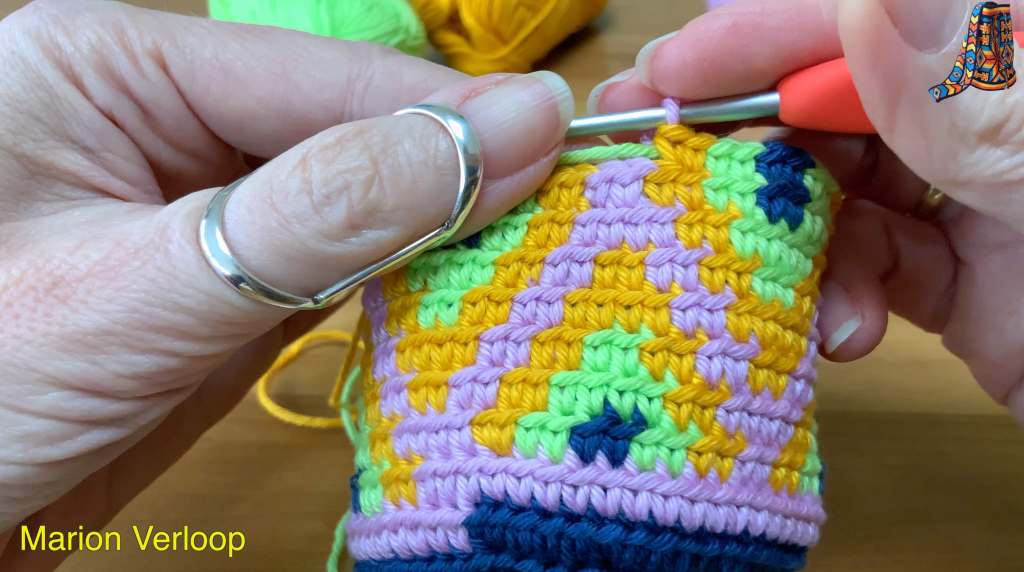
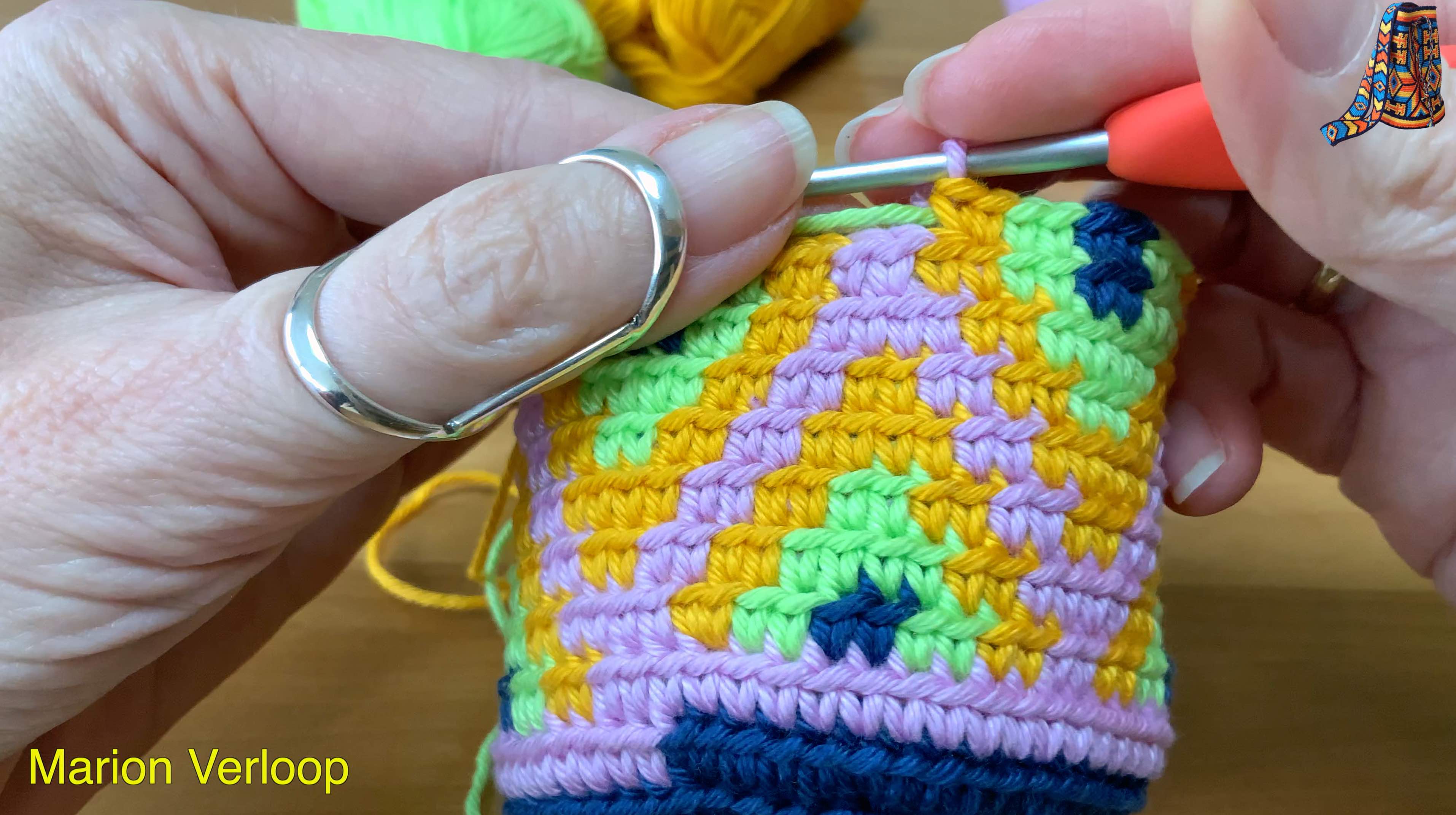
    Close-up of a Mochila crochet project demonstrating a technique to hide the ‘jog’ so the color change between spiral rounds is less visible.

    You can hide a ‘jog’ when you have vertical or diagonal lines in your pattern.

    When you have a vertical line, you can start crocheting before or after that vertical line in your pattern.

    You can hide the ‘jog’ by making an increase or a decrease when you have a diagonal line.

    I made a video about how to hide a ‘jog’ when you have a diagonal line in your pattern.

    I planned to make this video at the beginning of January, but then I got a cold and coughed for 5 weeks (no Corona). When the cough was finally gone, I made the video.

    By the time the video was almost finished, we were too busy with the ‘cal 2020’.

    This week my husband found time to edit the video and to update the website. And I found some time to write this blog. 😉

    The free pattern I used in the video is available on my website; Hiding the ‘jog

  • Never knew designing coasters was that hard.

    Never knew designing coasters was that hard.

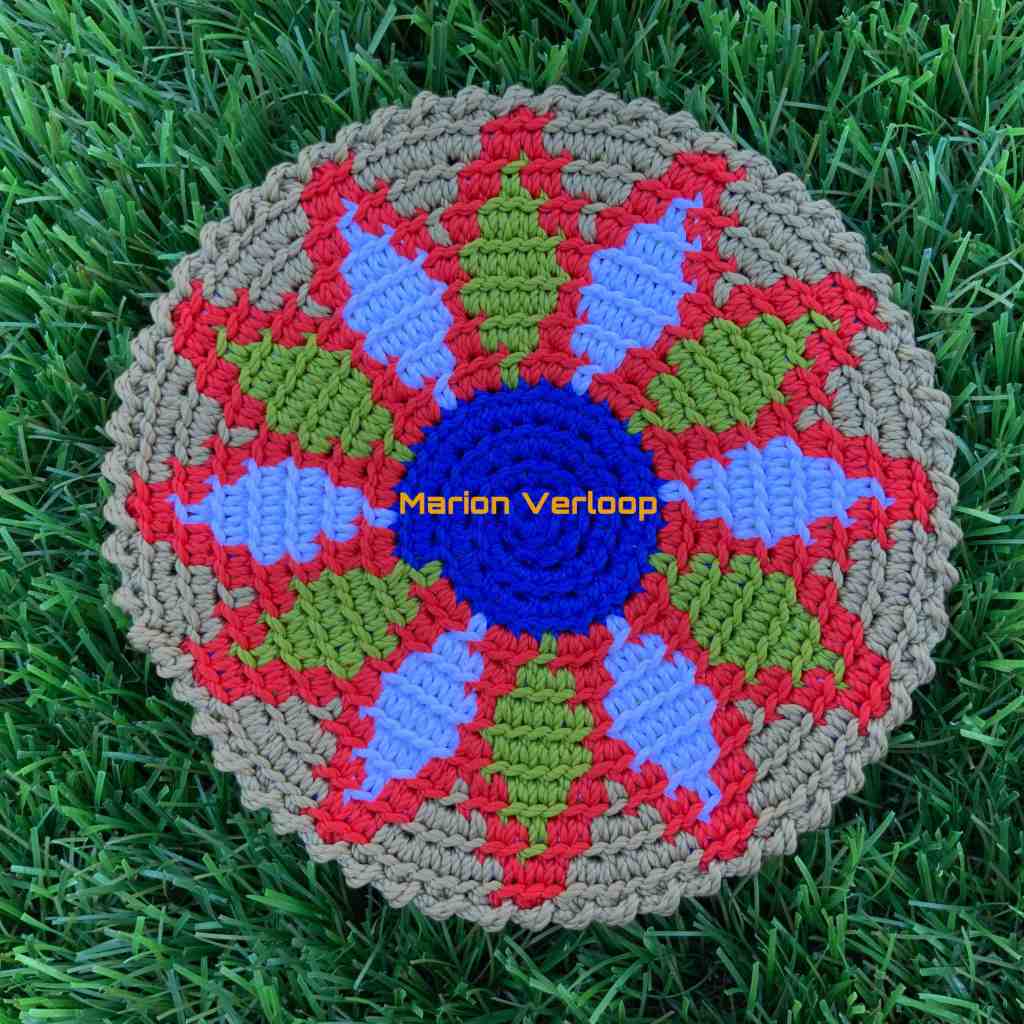
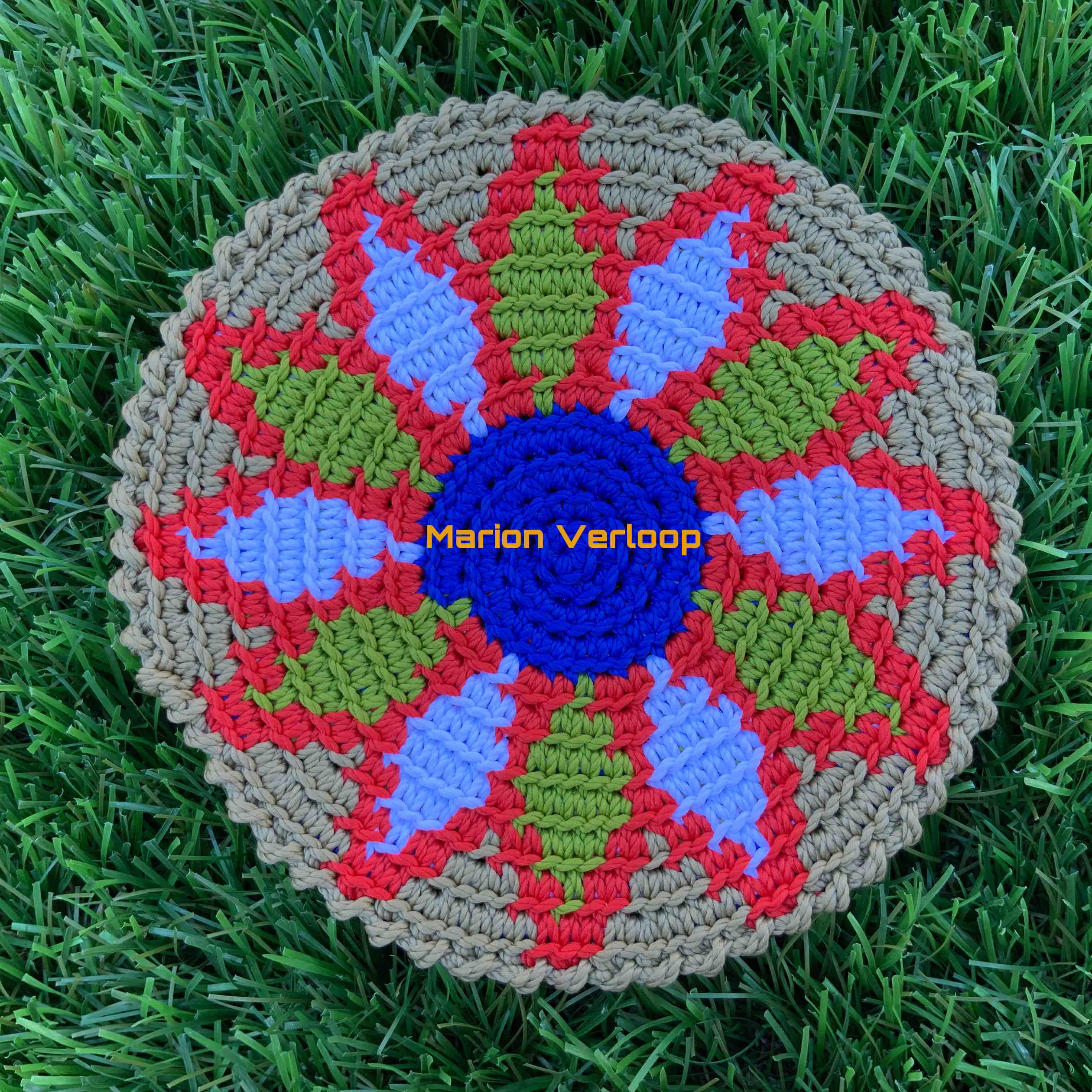
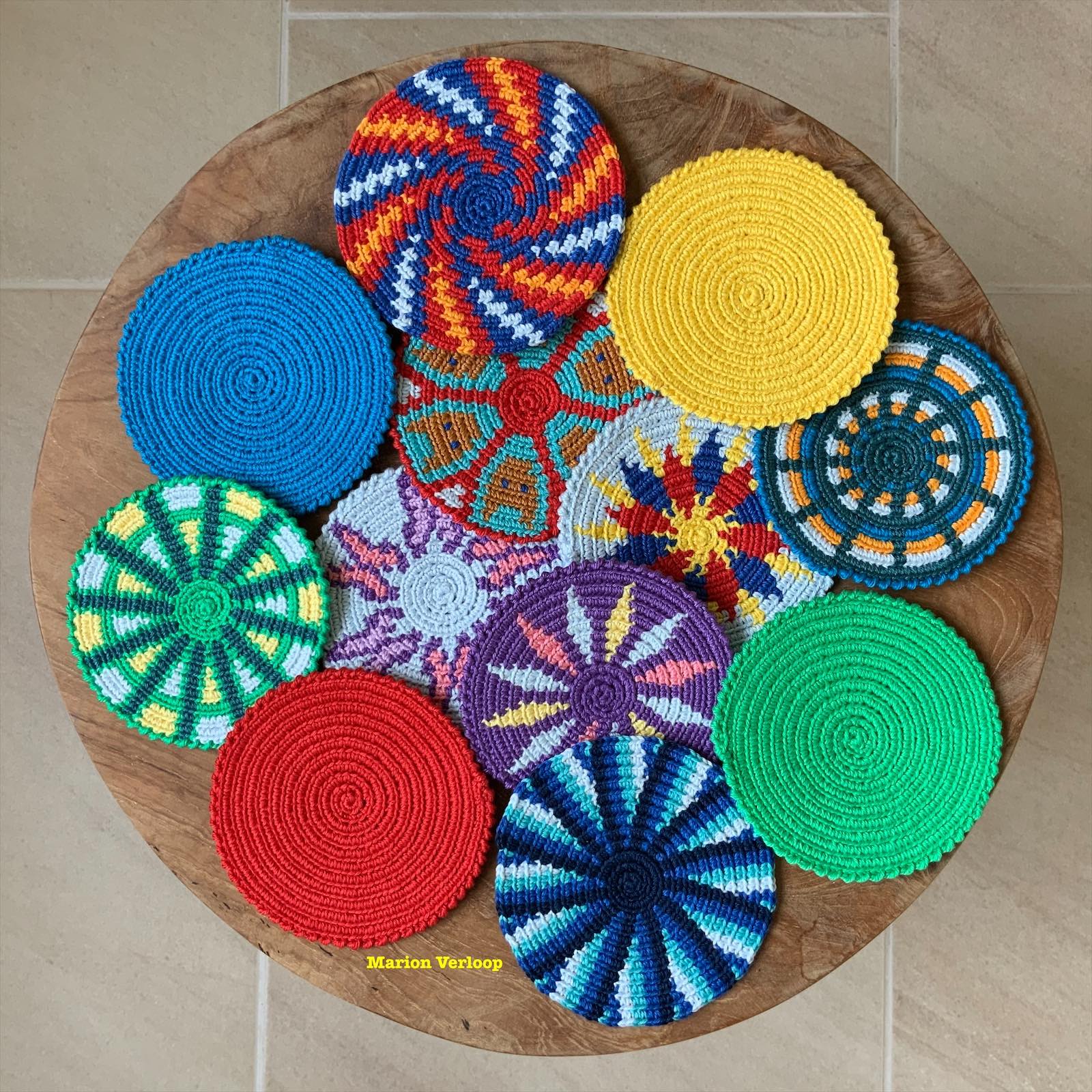
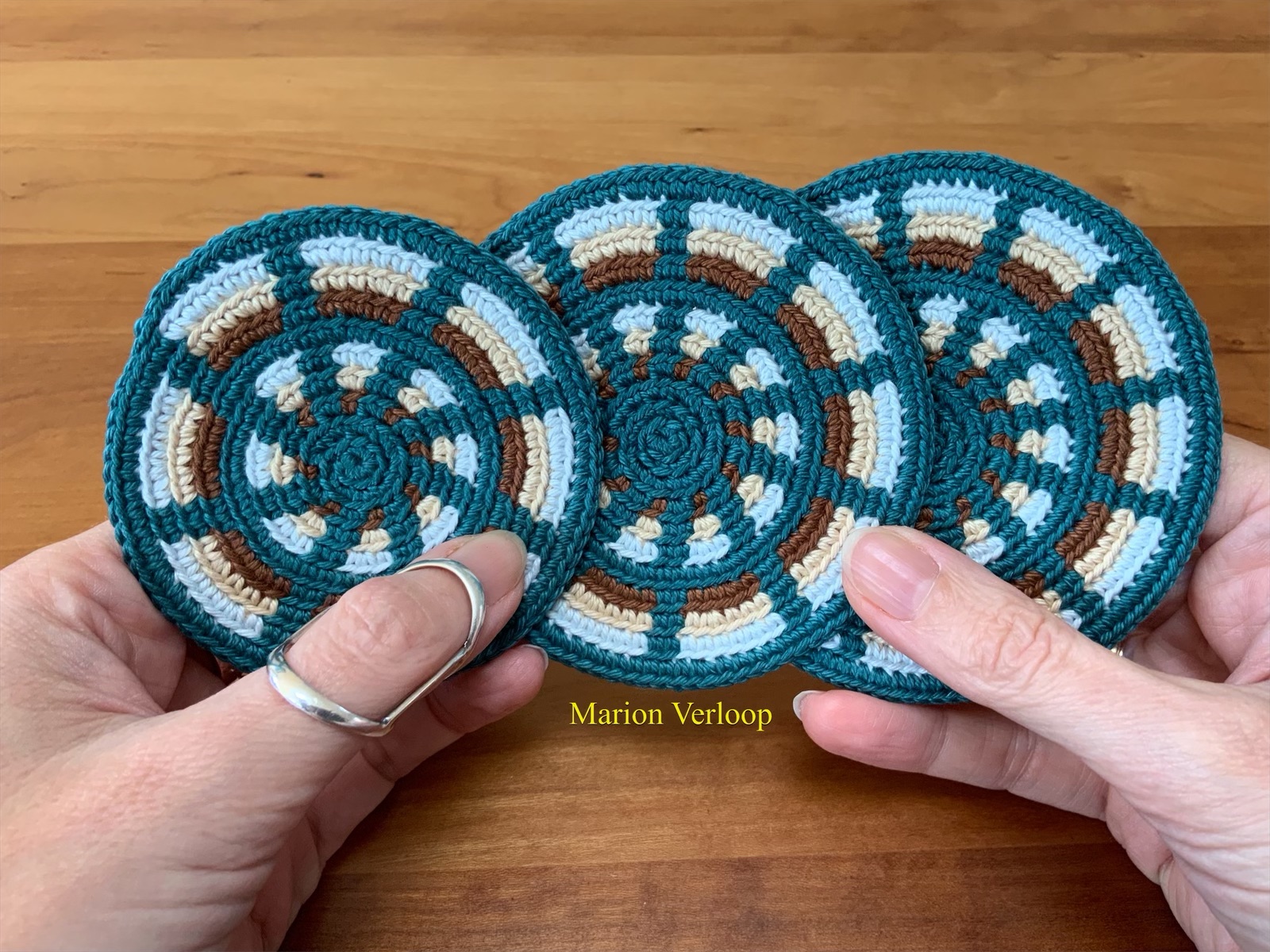
    In October I crocheted a few small bottoms, to show that there is not much difference in size when you increase 8, 10 or 12 times.

    After a while I put my cup of tea on those bottoms, so they have been promoted from YouTube examples to coasters.

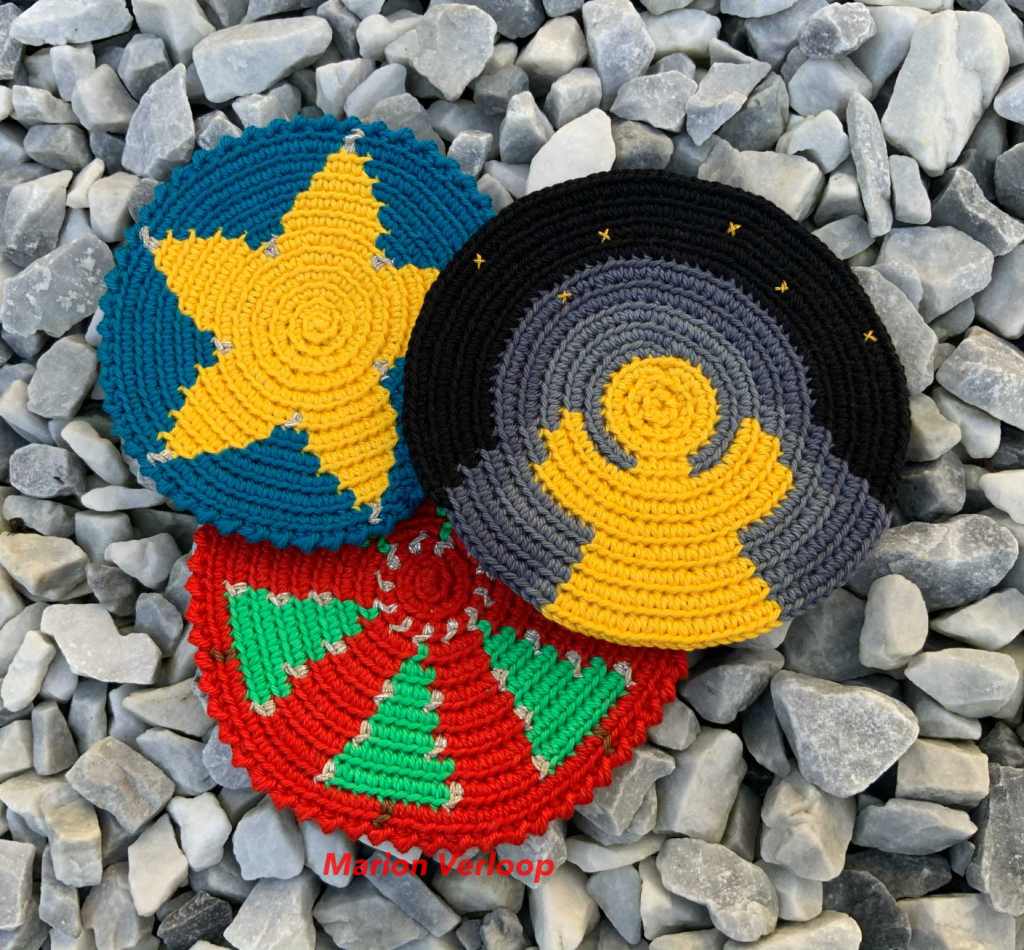
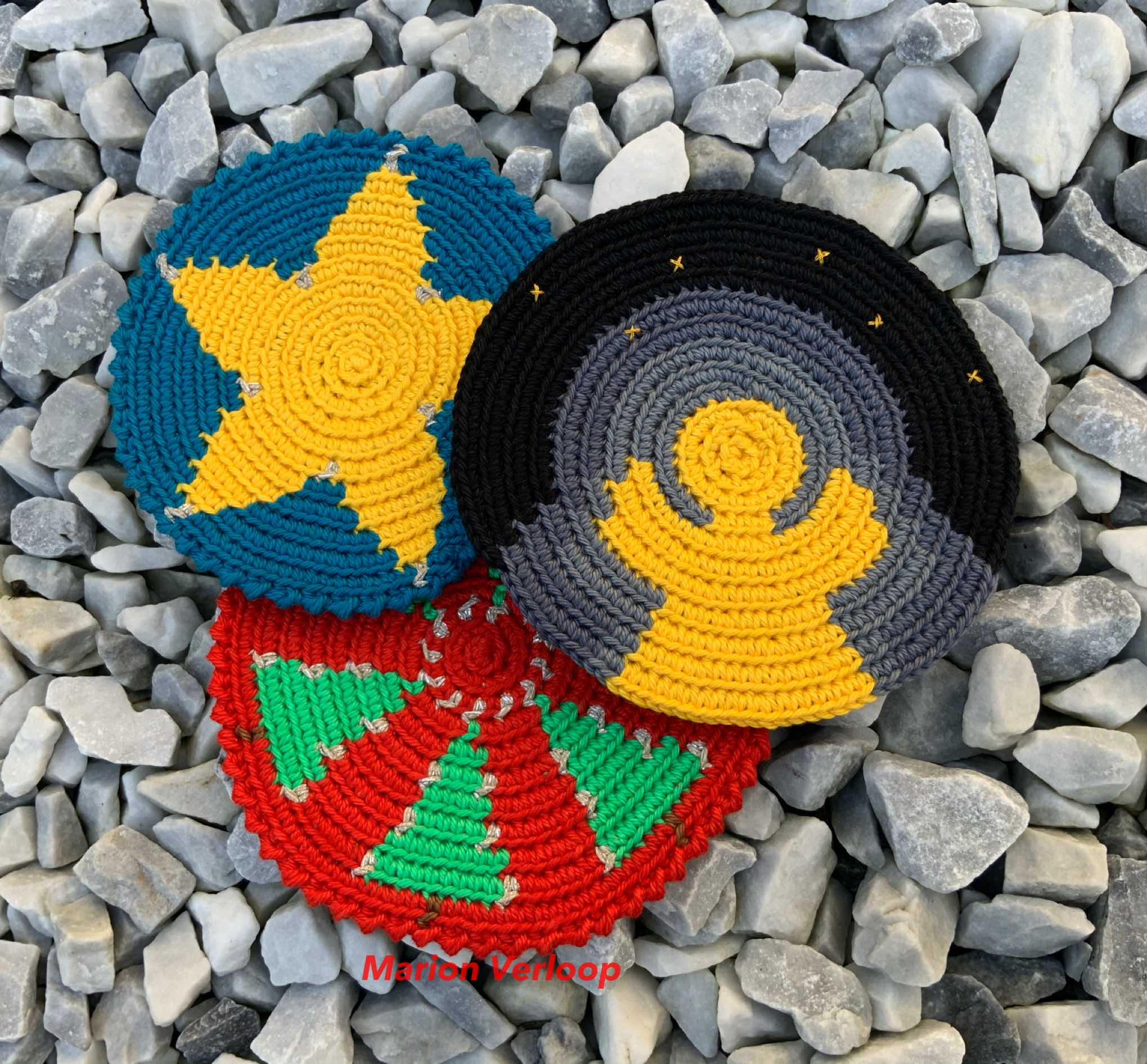
    A few weeks later I thought it would be nice to make some Christmas coasters too and I started to design a Christmas tree coaster.

    It took a few tries before it really looked like a Christmas tree. Making a straight Christmas tree on a round coaster was a challenge.

    Then I tried a Christmas bell, unfortunately it did not look good. No matter how often I changed my design, it looked more like an ugly Christmas tree than a beautiful Christmas bell. So that one didn’t make it into a pattern.

    The next try was a Christmas star. The design was a little challenging, but crocheting it went smooth. A Christmas star has 5 points, that is why I made the Christmas star coaster with 10 increases.

    The last one was the Christmas angel. Making the pattern was easy, crocheting it was a pain in the ass (sorry Angel). But in the end I am very happy with my lovely angel and I will make more of them for personal use. I think that one is fabulous.

    Reference: Christmas coasters

    Set of Mochila tapestry crochet Christmas coasters featuring a Christmas tree, star, and angel design.
  • What determines the size of a bottom?

    What determines the size of a bottom?

    Some people find it a bit hard to understand why the diameter of a Mochila bottom is not substantially bigger when you increase more stitches each round?

    A bottom with 20 rounds and 8 increases has 160 stitches in the last round. When you make the same bottom with 10 increases, you get 200 and with 12 increases you get 240 stitches. So if the bottom doesn’t get bigger where do these extra stitches go? The word math comes to mind, but that is a terrifying 😱 word for some people.

    To show that there is not much difference in diameter between 8, 10 and 12 increases, I decided to crocheted 3 small bottoms.

    I started with the 10 increase version and to my surprise I did not have any problems keeping the bottom flat and firm.

    Then the 8 increase version. 8 increases has always been a big problem for me, it always turned into a bowl. This time I was also able to keep this bottom flat and firm, but I did get painful fingers from heavily massaging the stitches.

    After a good night sleep, the bruised feeling in my fingers was gone and I was ready for the 12 increase version. 12 increases is normal for me, so I did not have any issues to keep it flat and firm.

    The 8 increase bottom has 10 rounds and the 10 and 12 increase bottoms have 11 rounds.

    With the 10 and 12 increase versions, you make one extra round in the beginning, so you don’t get a hole in the middle of the bottom. (You start with 5 or 6 stitches in the magic circle and then increase to 10 or 12.)

    The diameters of the test bottoms are:

    8 increases, 8,4 cm / 3.3 inch

    10 increases, 9,1 cm / 3.6 inch

    2 increases, 9,5 cm / 3.7 inch

    There is a 0,7 cm difference between the 8 and the 10 increases version, but that is mainly because the 10 increase version has one extra round.

    There is only 0,4 cm difference between 10 and 12 increases.

    When you continue and make full size bottoms, the difference in size will stay the same.

    Looking at these bottoms, it is clear that increasing more stitches each round does not make the bottom bigger. So where do these extra stitches go?

    When you increase more stitches each round, the stitches come closer together and that is the reason that the diameter does not get substantially bigger.

    With the 8 increase version I had 6 stitches in 2 cm.

    With the 10 increase version I had 7 stitches in 2 cm.

    With the 12 increase version I had 8 stitches in 2 cm.

    Three crocheted round Mochila bottoms side by side, each with a different number of increases per round (8, 10, and 12), illustrating the minimal difference in diameter.

    When you want to know the size of a bottom, always look at the number of rounds. The number of rounds and the hight of the stitches determine the size of a bottom.

    Now lets stop talking about numbers and go back to crochet 🧶 😄

    Related video

  • Weaving challenges

    Weaving challenges

    One day I was chatting with Giovanna Riemens-Carnibella, who is from Zeeland. (Zeeland is a Dutch province.) She told me that someday she would like to weave a band based on Zeeuws ‘Schortenbont’. Unfortunately she cannot weave, yet.

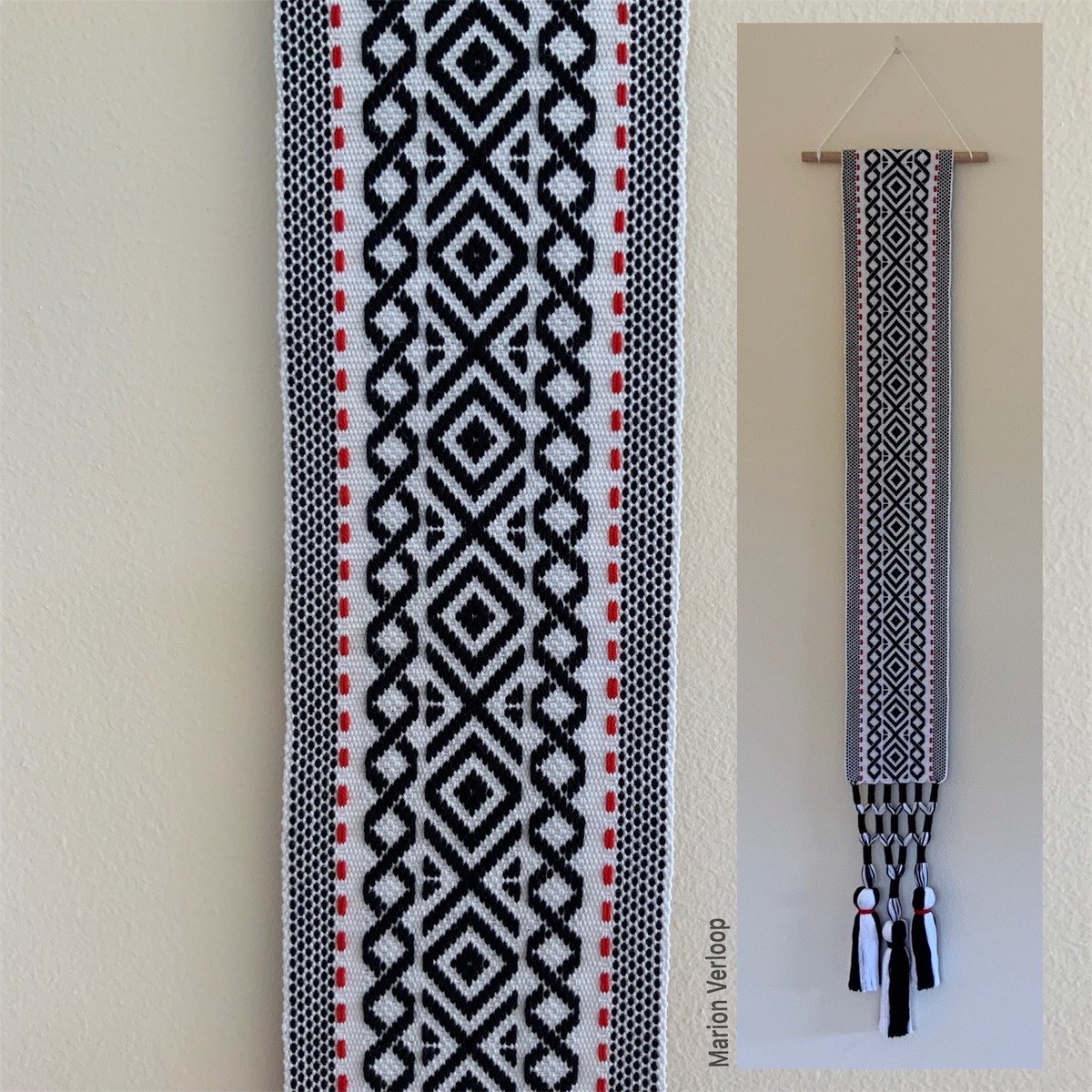
    ‘Schortenbont’ is a traditional fabric from Zeeland, it is usually black and white and sometimes red and white. When I heard about an exhibition and competition with the subject: “Black and white + ?”, I immediately thought, I can design a band inspired by ‘Schortenbont’ for that exhibition.

    So I warped my loom and started weaving, but noticed I made a huge mistake. 😢 My initial plan was to only weave the middle part, the red blocks and the dotted borders. Somehow I warped the double amount of black pattern threads. I have no clue how that happened. 😄 I had two options, take off half of the yarns, or redesign. I decided to change my design. Taking off half of the yarns would have been such a waste of yarn.

    After redesigning I had to change the warped yarns a bit. This was quite a challenge.

    I ended up with 183 yarns on my loom. This was almost too much for my loom. To prevent the yarns from falling off the pegs, I put some rubber bands on the ends of the pegs.

    Traditional woven band with a striped pattern, inspired by classic Dutch apron fabrics (schortenbont).

    In the end I was actually very happy that I made the mistake to warp the double amount of yarns, because now I had a really wide band.

    Now that the warp was correct, I could finally start weaving. When I was weaving, I ran into another challenge. The repeats of the different designs were not the same. For the little red blocks that was not a problem, you don’t really need a pattern for it. For the Baltic designs it was a little harder. I ended up using two small rulers. One for the middle design and one for the other design.

    The two outer designs are mirror images of each other. For the right design I read the pattern from right to left and for the left design I read the pattern from left to right.

    I thought it would be easy from now on. Unfortunately I was wrong 😔

    The red and black yarns started to get looser than the white yarns. I asked my weaving friends why this was happening. We talked about it and we came to the conclusion that it was because the red and black yarns are used for pick up/push down. When a yarn stays in the upper or lower layer, it takes less yarn than when the yarn goes up and down all the time, like the white yarns do. Because there was not enough tension on the black and red yarns anymore, the longer floats on my work became floppy. 〰️

    I started putting popsicle sticks under the red and black yarns to get the right tension again, but soon this was not enough. I ended with a little box under the red and black yarns. It was a real struggle keeping all the yarns under the same tension.

    When the band was 70 cm long I thought it was long enough. I didn’t want this band to end up in a drawer, like some of my bands. It is just too beautiful for that.

    So I decided to make it into a wall hanger.

    For the top part, I sawed a stick to the right length and made small cuts in the stick for the cord and sanded it all.

    Then I made a 4 stranded braid cord on the stick, so I could hang it.

    Back to the band. I cut off all the yarns at the top of the band and glued the ends. When the glue was dry, I sewed the band on the stick.

    Close-up of the bottom of a traditional Schortenbont woven band, showing yarn divided into groups and wrapped with black yarn, with tassels attached to the outer and central groups.

    The bottom of the band needed to be special, so I divided the yarns in 6 groups and wrapped them with black yarn. Then I divided those groups in 5 and then in 4 groups and also wrapped them with black yarn. On the outer groups I made tassels. I joined the two middle groups one more time and added a tassel to this group as well.

    I will enter this band in the exhibition and competition of the National weaving day in November 2019 in the Netherlands.

    If you still want to try to weave this band, after reading about all my struggles 🙃, then check the pattern section.

  • Congrats with your 50.000 YouTube subscribers

    Congrats with your 50.000 YouTube subscribers

    Hi Marion,

    Congratulations with your 50.000 YouTube subscribers!

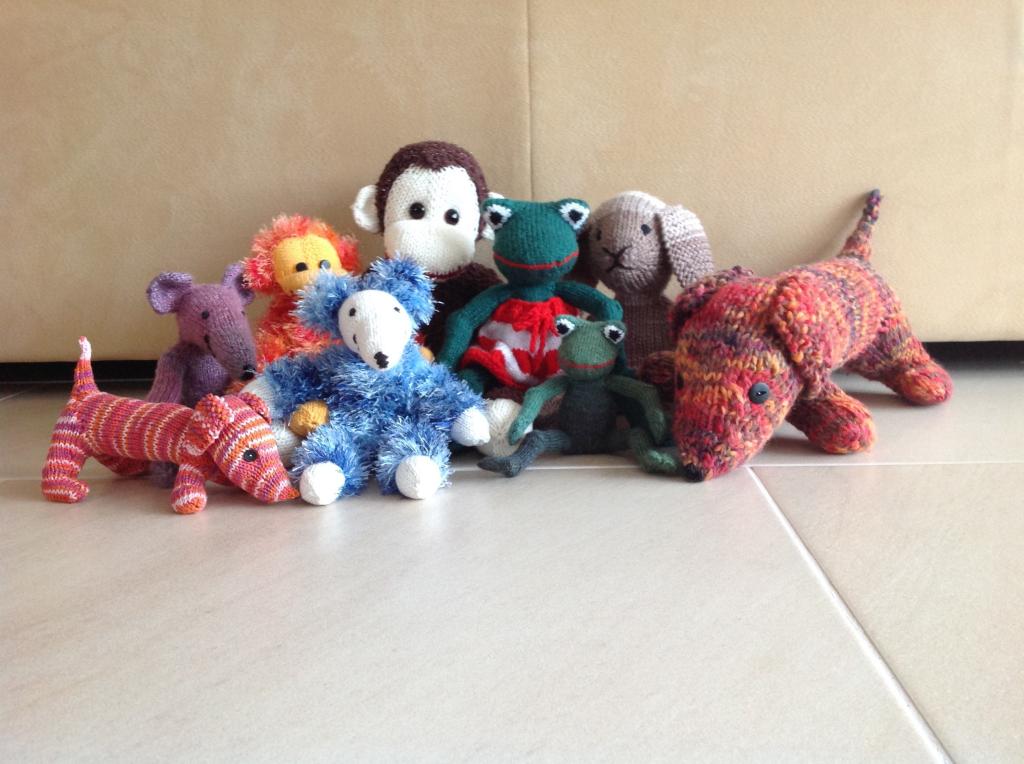
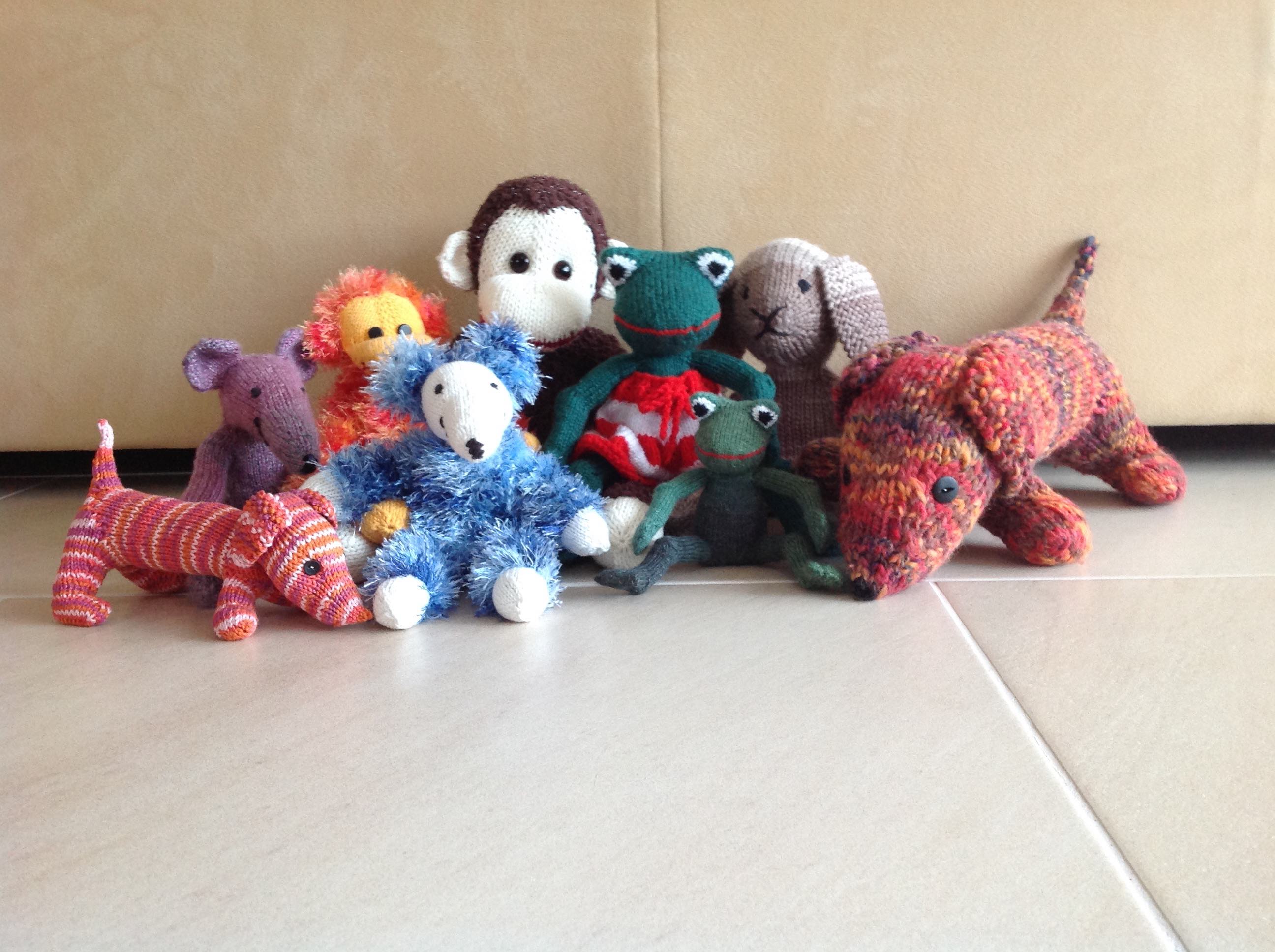
    A long time ago you knitted a lot. You made a lot of nice things like, scarfs, gloves, dresses, socks, sweaters, animals and bags.

    Later on you started crocheting Mochila bags. They were hard to make and you did not know how to do it, so you figured it out yourself and used internet for that too.

    A collection of hand-knitted animals, including various soft toys, displayed together as examples of past knitting projects.

    After a while you wanted to help other people and made the video “Mochila, the beginning, 8 increases”. It was so hard to get a flat bottom with 8 increases so an instruction video was a good idea. As far as I can remember you started the bottom all over again at least 15 times.😫 Put books on it and even jumped on it to get the bottom flat (or is the last one mine imagination😉).

    On 19 Februari 2015 you proudly uploaded your 1st YouTube video.

    After a few month you told me how many people already viewed your video and I was surprised. This video had been viewed 35.000 times. At that time I thought 35.000 different people watched it, but that was just a noob thought. Now we know, people watch instruction videos more than once to figure out how they have to do it right.

    Anyway, you had many ideas and made more videos to help others.

    Your crocheting technique improved and you started to add new things to the Mochila bags like a Kumihimo cord, crab stitch, double Moss stitch and you made several kinds of bands for your Mochila bags resulting into new videos.

    A lot of people struggle with the yarns when crocheting and an amazing amount of people like your video “Mochila, how to prevent the yarns from tangling”.

    At that time your English was already very good (especially compared to mine (96 versus 7)) but talking in your videos was a step too far for you, so I added a survey to one of your videos. The outcome was clear. By far the most people preferred you to talk in the videos. Yeah, I know, you were not happy with my survey🤪

    B.t.w. later on I also regretted it, as I had to put a lot more effort to edit the videos, especially the sound.😒

    And now? I am still very proud, so proud I write this blog to you.

    Between 2015 and 2019 you published 54 videos and more will come. It looks like a lot of people appreciate your videos and 50.016 subscribed to your Youtube channel.

    Love,

    Your hubby🤗😘

  • Finishing a WIP

    Finishing a WIP

    Some projects last long, like the one I just finished.

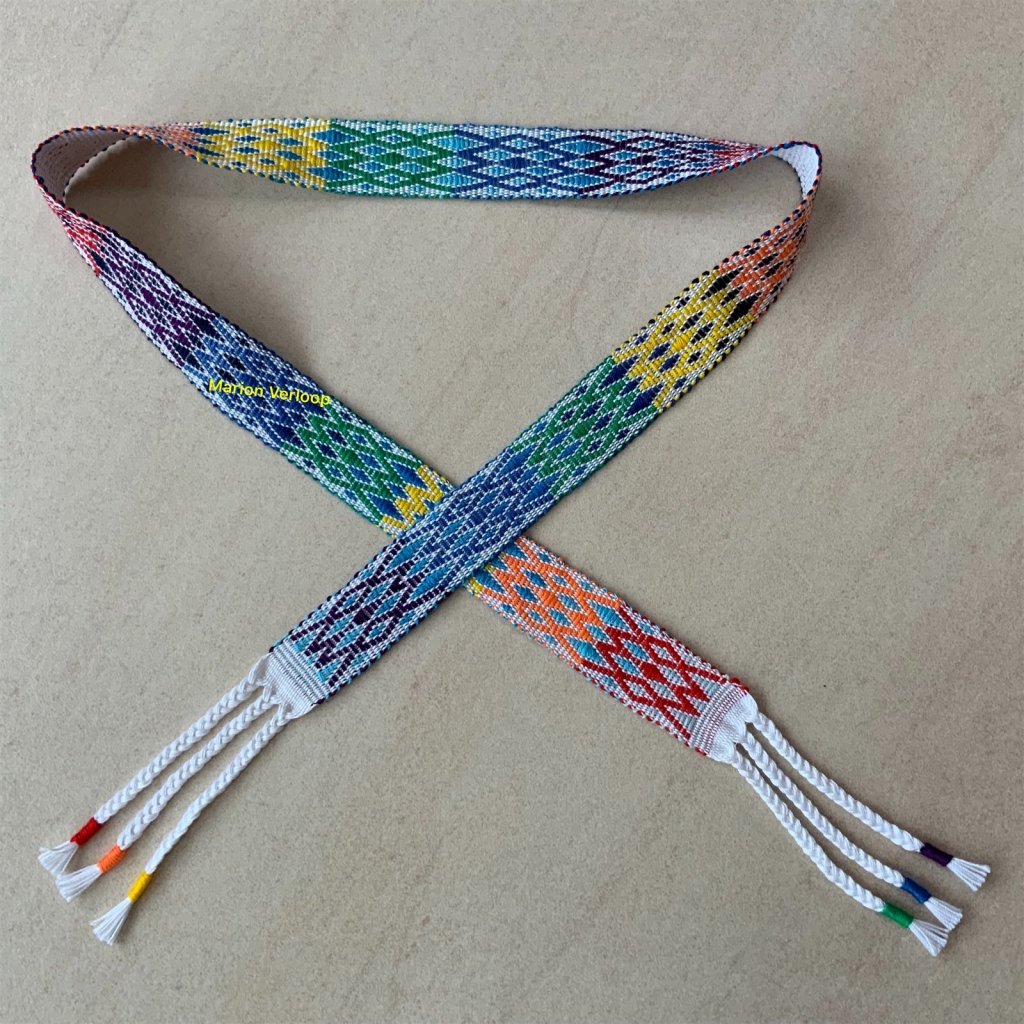
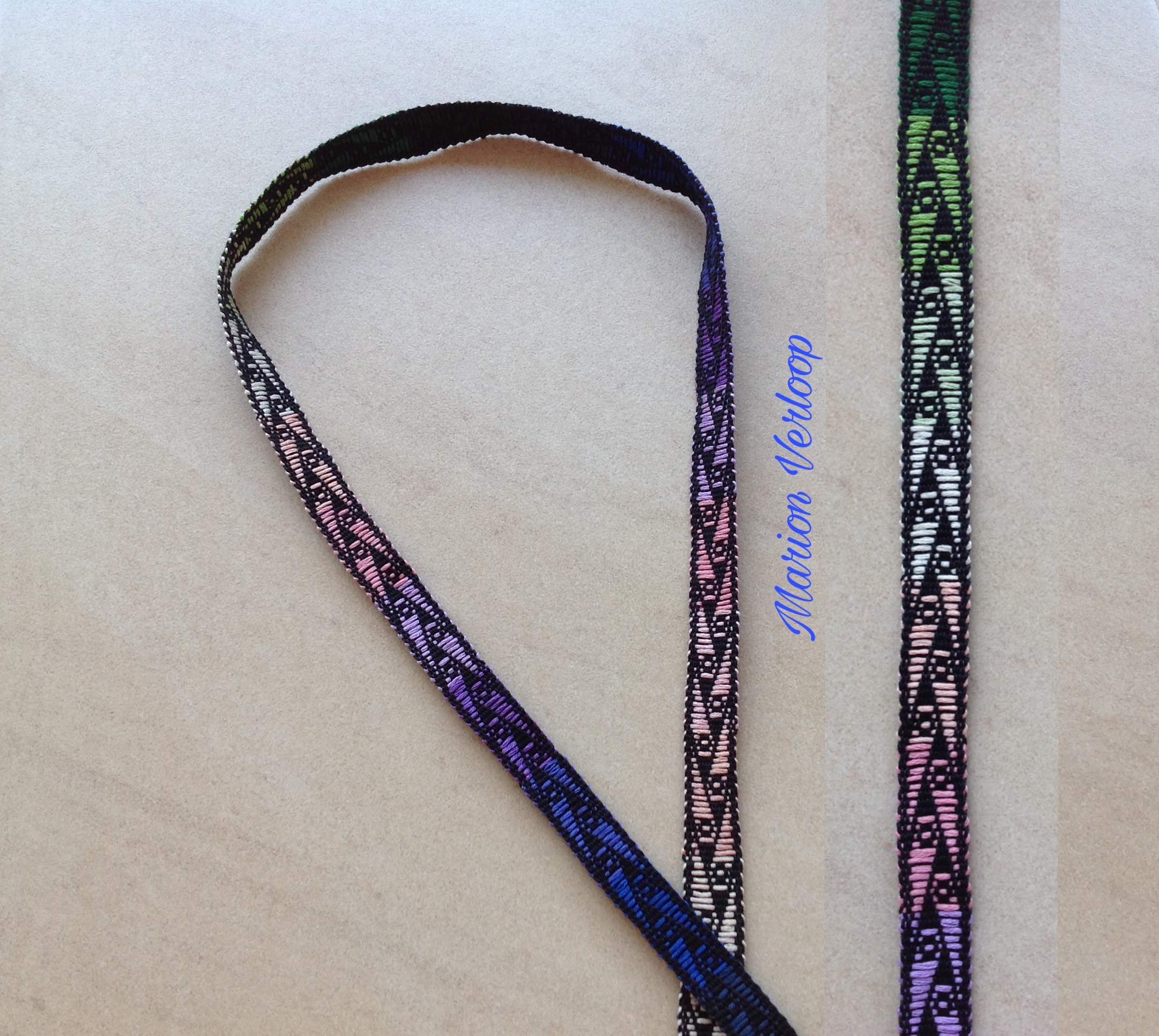
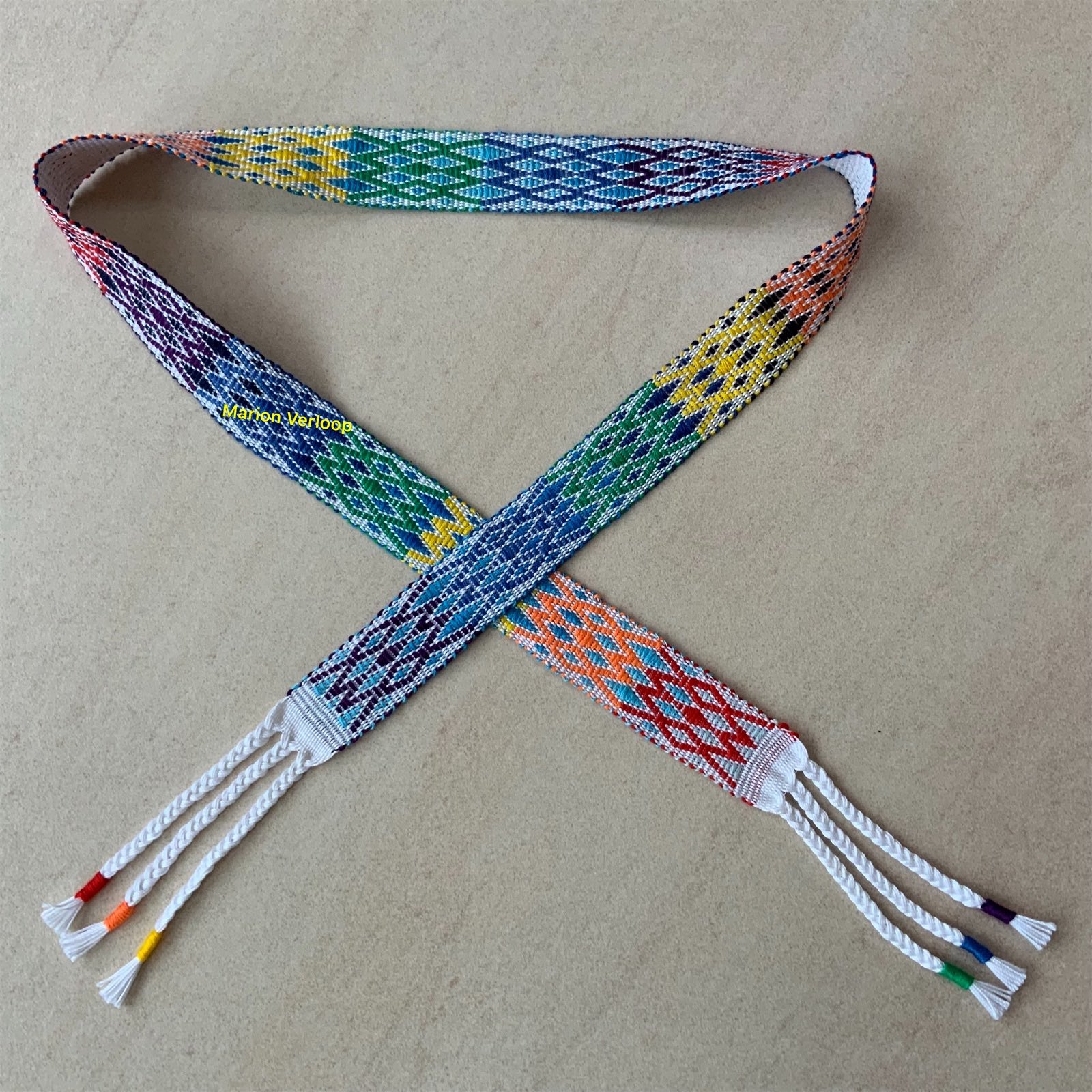
    Handwoven band made with the supplementary weft technique, featuring rainbow colors and shades of blue.

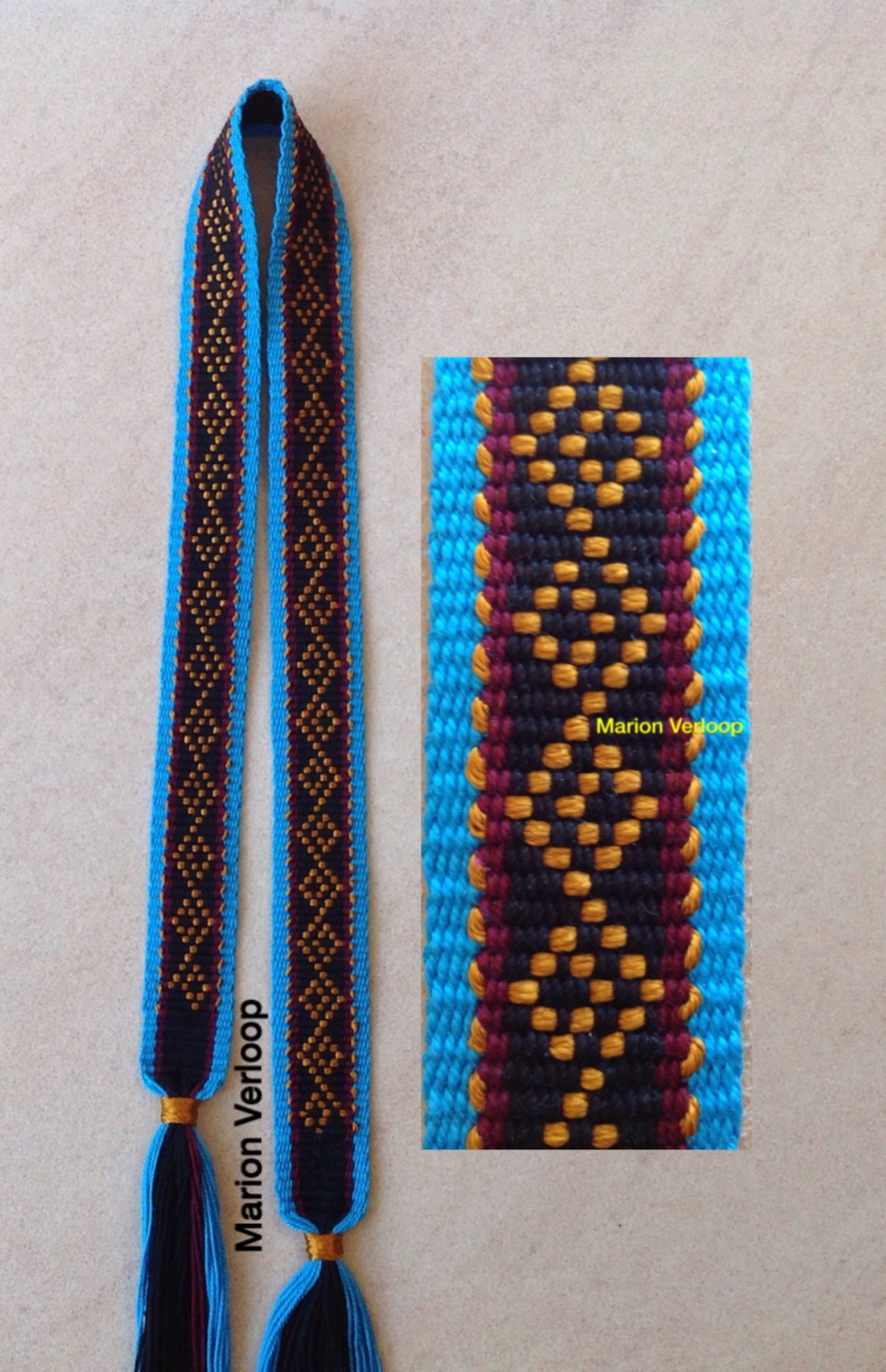
    In February 2018 I learned the supplementary weft technique together with some friends in the workshop “Andean weaving”. It is always great to weave with friends. The teachers did a good job, but I didn’t really like the example pattern we had to make. I started with the pattern they gave us, but in the evening I undid my work. I designed my own pattern and started over. For this band I used shinny golden embroidery floss for the extra weft.

    I really enjoyed learning this technique.

    During the workshop the teachers showed a few bands they made with this technique. I really liked one of the bands.

    A few weeks later I drew that pattern, took a dive in my embroidery floss stash and started weaving. I was really happy with the result.

    Handwoven band made with the supplementary weft technique, featuring rainbow colors and shades of blue.

    Later I saw the same technique with 2 supplementary weft threads that some of my friends made and it looked very very nice so I wanted to try that too.

    A few days later a beautiful rainbow band popped in my mind, 🌈 so I designed a pattern for it. I warped my loom and selected embroidery floss. For this band I chose rainbow colors and different shades of blue.

    I started weaving this band in October 2018.

    Like many other people, I had too many projects going, so I didn’t really have the time to work on it.

    But now it is finished 😀 and I am really happy with the result. 😁

    Cheerful woven band with a rainbow pattern, created using supplementary weft threads for added color and texture.

    I don’t know what you think about sewing in loose ends, it is not my favourite part of any crafting technique.

    The supplementary weft technique with many colors results in a lot of loose ends. The good part is that after sewing in the loose ends you have a beautiful band to be proud of.

    For explanation of this technique check this tutorial by Marieke Kranenburg. https://www.etsy.com/listing/686782536/inkle-weaving-with-supplementary-weft?ref=shop_home_active_1

    The pattern for the rainbow band with 2 supplementary weft threads can be found on this site on the ‘Pattern’ page.

  • Painful fingers

    Painful fingers

    In my videos you see me wearing a thumb ring.

    I get many question about my ring. For example:

    Wow, what a great ring. Where can I get one?

    Oh I think I need a ring like that, I have … Where did you get it?

    Can you please take off that ring? It is distracting.

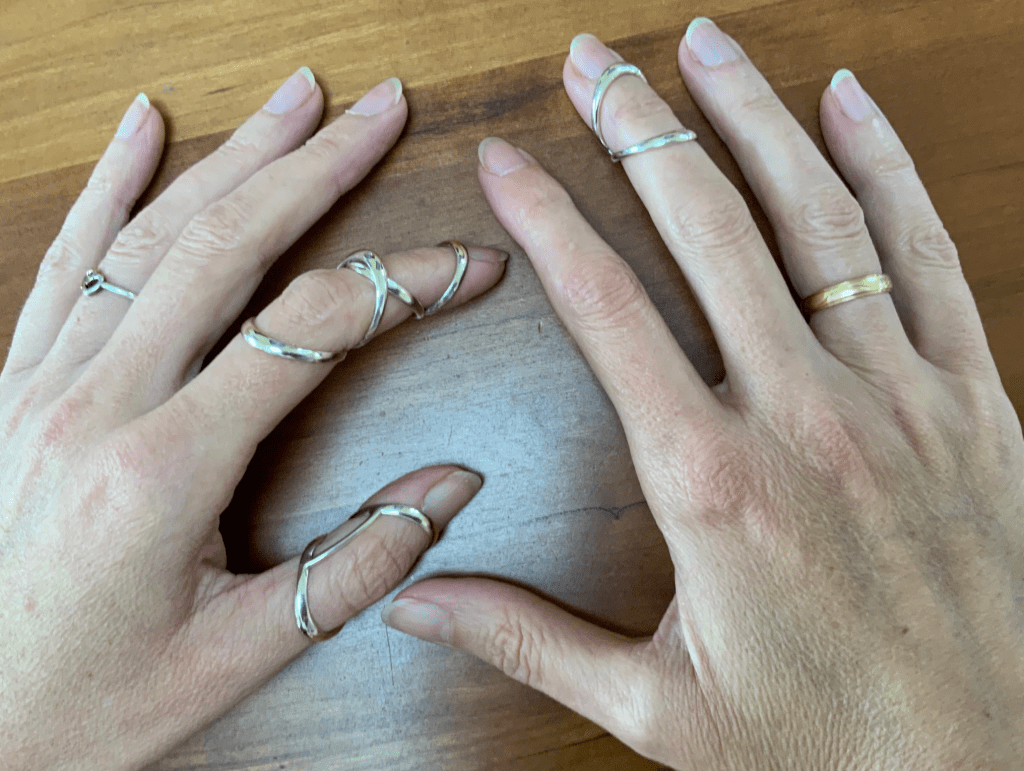
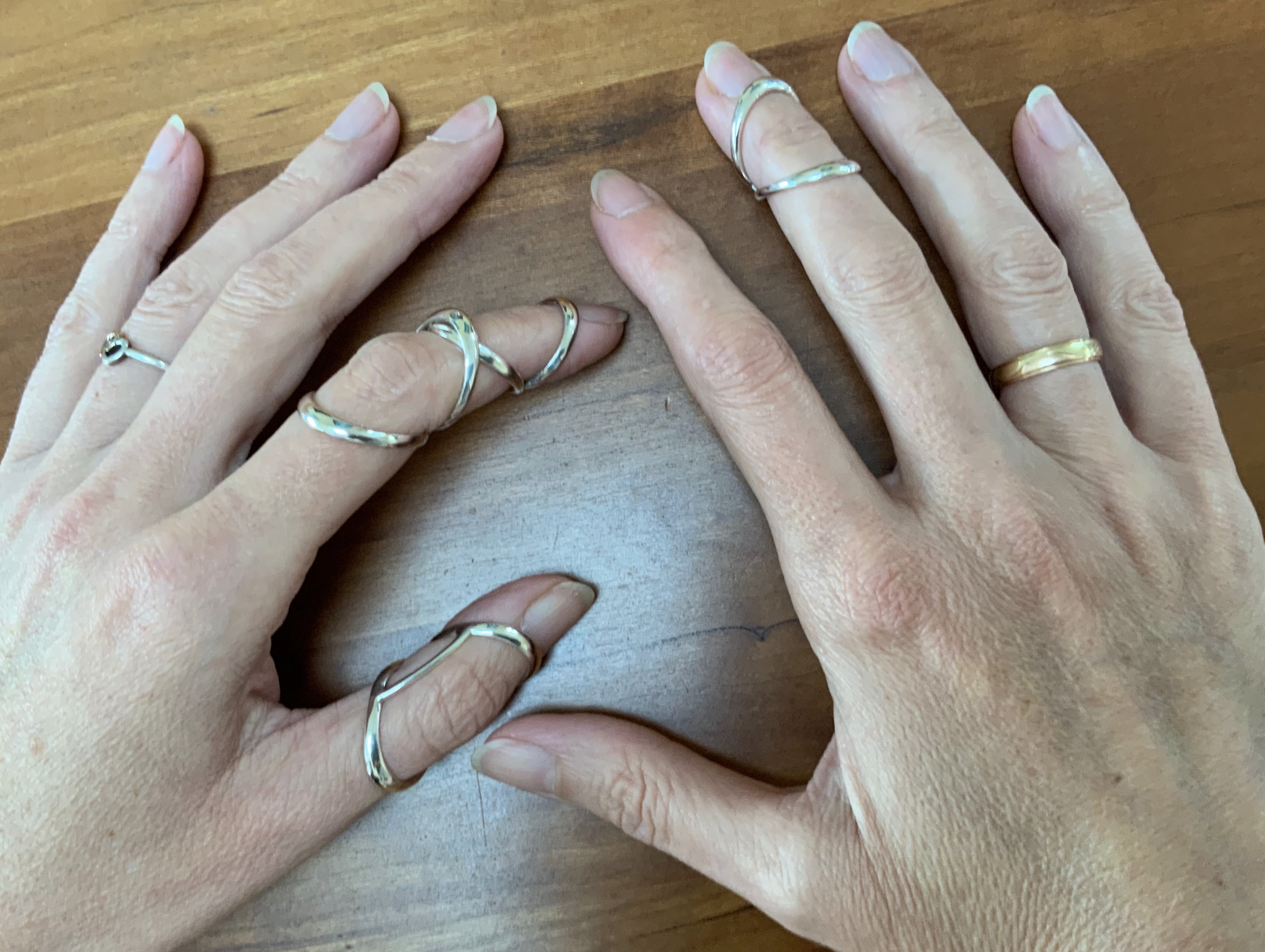
    My ring is not a fashion statement. It is a brace, a beautiful one, but still a brace. The ring is called a Silver splint. The joints in my fingers and arms are hyper mobile, this means that they can bend the wrong way.

    For many years this was no problem. I even liked it as a kid. I could do some amazing tricks with my fingers. Now that I am getting older, some joints are starting to hurt.

    Close-up of a hand wearing a silver splint ring on the thumb, used as a brace to support hypermobile finger joints.

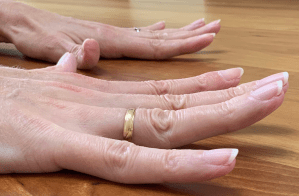
    Some of my fingers bend 90 degrees backwards, my husband’s fingers bend zero degrees backwards. We used to argue about who is ‘normal’. Of course we both thought we were normal.

    A few years ago my fingers started to hurt, so I went to a specialist. Unfortunately she told me, my fingers are not normal 😔 I still believe my husband’s fingers are also not normal though😄

    When I do not wear the thumb ring, I can not crochet without pain. I have more rings, but in the videos I only wear my thumb ring, otherwise you would only see silver 🤨 then it would really be distracting.

    On a daily bases I wear another ring, on the dip joint of my right hand middle finger.

    When I crochet with thin yarn, I wear 2 more rings on my left hand index finger. One for the dip joint and one for the pip joint. These joints used to bother me a lot, but now that I wear the thumb ring, those joints don’t hurts so much anymore.

    Scary, right.

    Close-up of a hand wearing multiple custom-made silver splint rings on the finger joints, providing support for hypermobility.

    Silver splints

    My rings are custom made by a company called WeDesign. I am fortunate that my health insurance payed for the rings.

    I have seen silver splints on Amazon. Some look good, but I also saw some very thin versions. I don’t think they are strong enough to last more than a day.

    If you think you need a Silver splint, please do some research. You don’t want to spend money and then be disappointed.

    A Silver splints can be used for several reasons, Rheumatoid Arthritis, Arthrosis, Hyperextension and luxation of the joints due to Ehlers Danlos Syndrome, Hypermobility Syndrome, muscle dystrophy, collateral ligament instability and Multiple Sclerosis.

    If you have any questions about my rings, feel free to ask me.

  • Mochila Mystery

    Mochila Mystery

    Finally I can show you my new bag ‘Mochila Mystery’.

    Last year in June I came up with a new stitch, the ‘Marion stitch’. With the ‘Marion stitch’ you have horizontal yarns over the stitches.

    ‘Mochila Mystery’ is a pattern for the more experienced Mochila makers.

    This bag has two short straps and it closes with a magnet.

    It took a while to come up with a good design.

    My husband helped with designing.

    He made a sketch and then I drew the pattern to see if it would be possible to crochet it. When I was crocheting what I drew, I found out that even tho it was possible to crochet it, it did not always look good 😃 Some things looked good on paper, but did not look good when crocheted.

    Mochila Mystery Challenge yourself with the Mochila Mystery pattern! This striking bag is made using single crochet through the back loop and is worked over six yarns, making it extra sturdy and unique. Designed for more experienced Mochila makers, the pattern includes clear written instructions, detailed charts, and helpful video links for the special techniques.

    At first the background of the big diamond, in the middle of the bag, was crocheted in yellow with the ‘Marion stitch’ over it. That made the ‘Marion stitch’ less visible. So I decided to just crochet big stripes in different colors. With the ‘Marion stitch’ I made the patterns on the stripes.

    It took several 🐸 frogging sessions before I was happy with the pattern. I have probably crocheted the side of the bag twice 😄 before I was completely happy.

    For this bag I challenged myself to choose colors out of my comfort zone. During the making of the bag, the colors started to grow on me 😃

    Another challenge was to make an oval bottom with a pattern in it, I am really happy with the result. My oldest son was able to make a graph for the oval bottom.

    I love to see in what colors ‘Mochila Mystery’ will be made. And I am very curious, what designs will be made with the ‘Marion stitch’.

    References:

  • From stuffed animal beds to Mochila bags.

    From stuffed animal beds to Mochila bags.

    Many times my husband said: Why don’t you make a site. I always said something like: No I wouldn’t know what to put on a site and I am not going to make a blog.

    Finally my husband decided to make a site for me. So here I am writing my first blog post 🙂

    When I was little, my mother was always knitting. When my grandmother came to visit us for a few days, she was always knitting too. Once she knitted a sweater for me in 3 days. I loved that sweater. It was orange and it had a hoody. I wore it for years. I was really mad at my mother when I found out she threw it away. It still looked great in my eyes 😃

    When I was 5 my mother taught me how to knit. I knitted little sweaters and beds for my stuffed animals. Later I knitted sweater for myself.

    When I was about 15 years old, I wanted to learn how to do cross stitch. My parents didn’t want to buy it for me. They said, finish what your sister started, when you still like it after finishing it, we will buy new materials. And so I finished what my sister started. It was something with violets.

    After that I made a lot of cross stitch paintings.

    When a baby was born in the family, I made something with cross stitch. I made paintings, a growth chart and a baby hooded towel. I embroidered on the hoody of the baby towel.

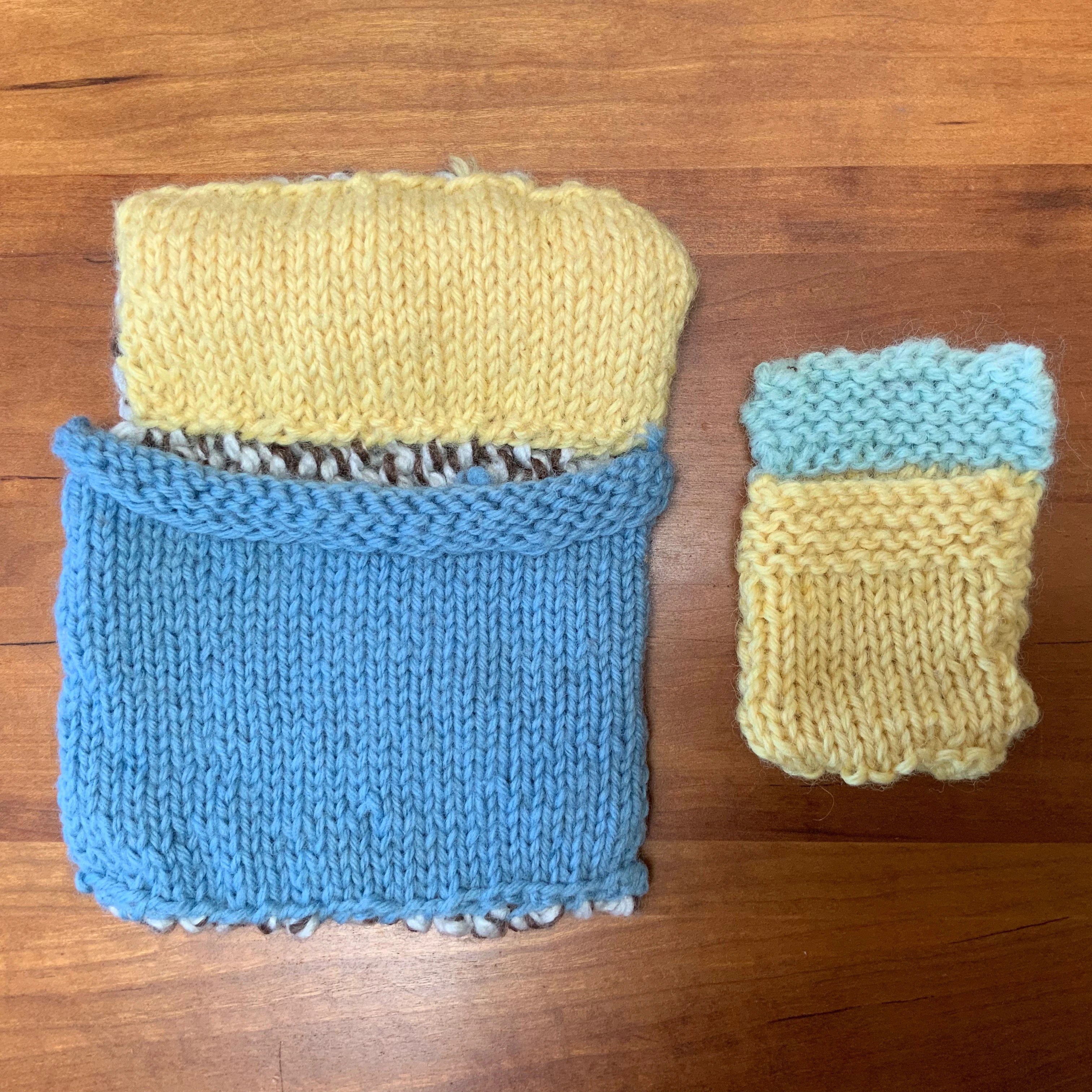
    Stuffed animal beds.

    Stuffed animal beds. (I still have them)

    When my brother and sister in law announced that they where going to have twins, I started knitting again. I bought circular needles and made cute stuffed animals for my nieces.

    In 2011 my mother taught me how to crochet.

    In 2014 I started making Mochilas. I have been addicted ever since.